









Generative engine optimization, or GEO, is the practice of making your brand, content, and proof easy for AI systems to find, understand, cite, and recommend. It builds on AI SEO and AI search visibility, but the target is broader than ranking one page in one results list.
Classic SEO asks, “Can this page rank for the query?” GEO asks, “Can an answer engine trust this entity enough to include it in a generated response?” That question matters across Google AI Overviews, Google AI Mode, ChatGPT Search, Perplexity, Bing Copilot Search, Gemini, Claude with web access, and the next wave of agentic research tools.
The shift is not theoretical. Google has reported AI Overviews reaching more than a billion users, AI Mode expanded from experiment to a core Search experience, and Adobe Analytics reported a sharp rise in generative AI referrals to U.S. retail sites. Those signals do not mean traditional SEO is dead. They mean search behavior now includes generated answers, citations, brand mentions, and follow-up conversations.
The practical goal of GEO is simple: become the source an AI system can confidently use. That requires useful pages, technical accessibility, entity clarity, external validation, structured evidence, and a measurement process that catches where your brand appears, disappears, or gets described incorrectly.
That source quality starts on your own site. An AI-friendly website gives GEO work cleaner HTML, markdown-ready summaries, semantic headings, and explicit agent negotiation points.
What Is Generative Engine Optimization?
Generative engine optimization is the work of improving your presence in AI-generated answers. A GEO program connects crawlable content, entity SEO, LLM seeding, structured data, citations, reviews, and third-party mentions so generative systems have enough evidence to mention or cite you.
A generative engine is any system that uses AI to synthesize an answer instead of only returning a ranked list of links. Google AI Overviews summarize topics inside Search. Perplexity answers with citations. ChatGPT Search can blend conversational reasoning with web results. AI Mode can break a complex question into related searches and bring the user back a synthesized path.
GEO does not replace SEO fundamentals. It raises the standard for them. A slow, thin, unclear, uncited page will struggle in classic search and will struggle even more when an AI system compares it against many sources before writing an answer.
Here is the clean definition:
| GEO Element | What It Means | Why It Matters |
|---|---|---|
| Findability | AI systems can crawl, retrieve, or discover your content | Invisible evidence cannot support an answer |
| Understandability | Your pages explain entities, attributes, claims, and relationships clearly | The system can classify your brand and topic accurately |
| Trust | Other sources confirm your claims, expertise, and category fit | The system has less risk when it cites or recommends you |
| Usefulness | Your content answers the exact subquestions users ask | The answer engine can reuse passages, tables, examples, and explanations |
| Measurement | You track mentions, citations, sentiment, and source overlap | You can improve the evidence system instead of guessing |
How Is GEO Different From Traditional SEO?
GEO differs from traditional SEO because it optimizes for inclusion in generated answers, not only blue-link rankings. A strong GEO strategy still needs technical SEO audits and SEO content, but it also needs source coverage beyond your own website.
Traditional SEO usually starts with a keyword, a SERP, and a page. GEO often starts with a prompt, a task, and a set of sources the AI system may consult. The answer engine may need a definition, a comparison, reviews, pricing evidence, documentation, community sentiment, and expert commentary before it decides what to say.
That makes the optimization surface wider:
| Area | Traditional SEO | GEO |
|---|---|---|
| Primary target | Organic rankings | AI answers, mentions, and citations |
| Query format | Keywords and questions | Prompts, follow-ups, and tasks |
| Main asset | Optimized pages | Connected evidence across sources |
| Authority signal | Links, topical depth, content quality | Links, mentions, citations, reviews, and corroboration |
| Measurement | Rankings, impressions, clicks, conversions | Mentions, citations, source overlap, sentiment, and assisted demand |
| Failure mode | Page does not rank | Brand is absent, misdescribed, or unsupported |
The mistake is treating GEO as a magic wrapper around existing content. If the content does not answer the question clearly, if the brand entity is vague, or if the web cannot corroborate the claim, the generated answer has little reason to include you.
Why Does GEO Matter Now?
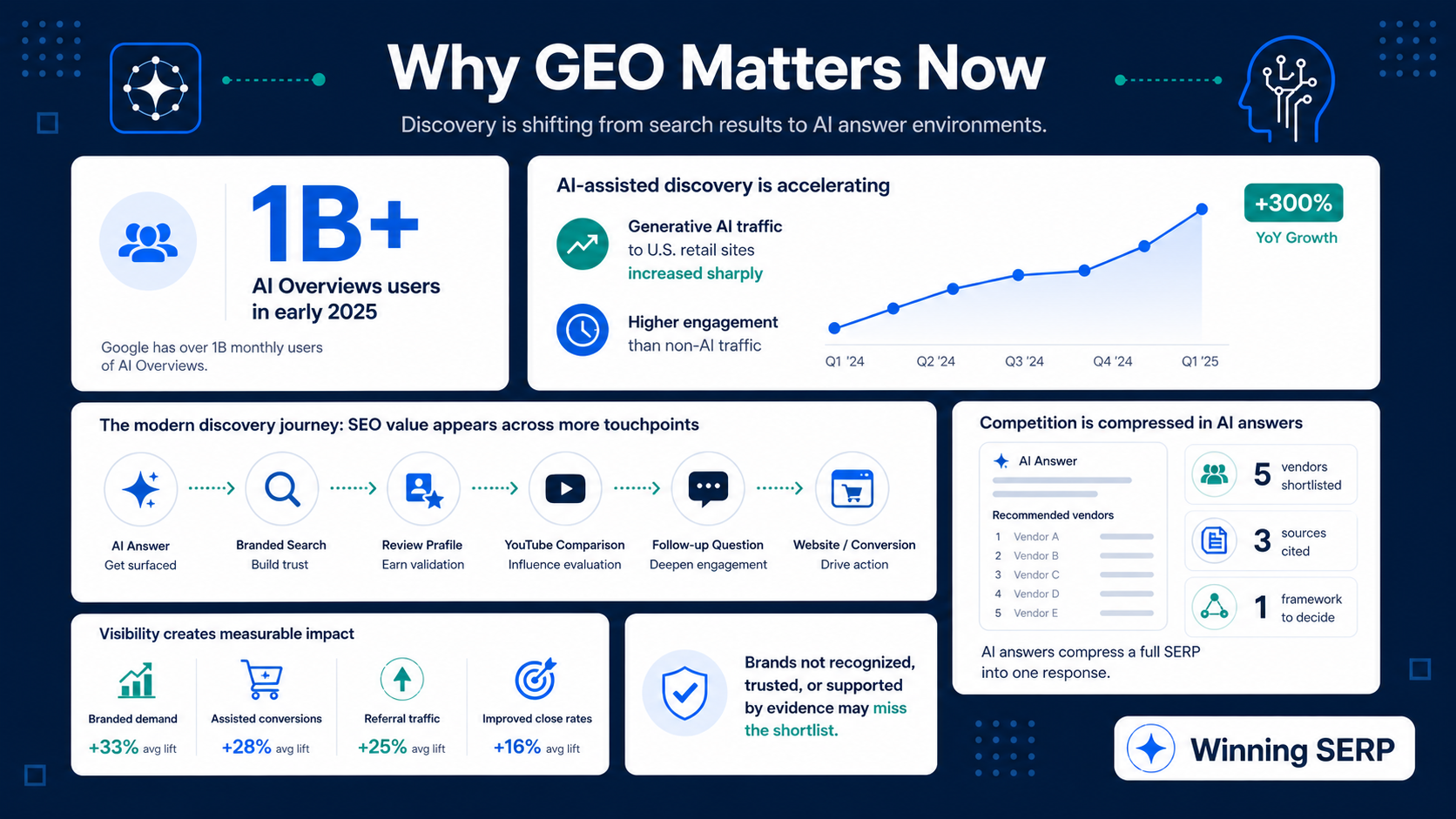
GEO matters now because discovery is moving from search results to answer environments. Users still search Google, but they also ask AI search engines and AI assistants to compare options, summarize research, explain tradeoffs, and recommend providers.
Google said AI Overviews were used by more than a billion people in early 2025 and later expanded AI Mode as a deeper Search experience. Adobe Analytics reported that traffic from generative AI sources to U.S. retail websites increased sharply, and that those visitors showed stronger engagement signals than non-AI traffic. Even when the exact numbers vary by industry, the direction is clear: AI-assisted discovery is becoming part of the buying journey.
This changes how SEO value appears. A user may see your brand inside an AI answer, search your name later, click a review profile, watch a YouTube comparison, or ask a follow-up before visiting your website. The influence may show up as branded demand, assisted conversions, referral traffic, or improved close rates rather than a neat last-click organic session.
The visibility layer is also becoming more competitive. If an answer engine names five vendors, cites three sources, or summarizes one framework, it has compressed a SERP worth of discovery into a short response. Brands that are not recognized, trusted, or supported by evidence may not make the shortlist.
Which AI Surfaces Should GEO Cover?
GEO should cover the AI surfaces that influence your buyers, not every assistant on the internet. Most teams should start with Google AI Overviews, Google AI Mode, ChatGPT Search, Perplexity, Bing Copilot Search, and any vertical platforms that shape their category.
Each surface behaves differently. Google AI Overviews live inside a traditional search environment. ChatGPT Search feels conversational. Perplexity emphasizes citations. AI Mode supports longer, multi-step exploration. That is why prompt research and manual answer review matter before you decide what to optimize.
Use this surface map to prioritize:
| Surface | Best For | GEO Implication |
|---|---|---|
| Google AI Overviews | Informational, commercial, and complex Search queries | Make pages source-worthy, crawlable, and aligned with Search fundamentals |
| Google AI Mode | Multi-step questions and follow-up exploration | Cover subtopics, comparisons, entities, and decision paths |
| ChatGPT Search | Conversational research and brand discovery | Build clean content, external proof, and source coverage |
| Perplexity | Citation-led research and comparisons | Earn mentions on sources that Perplexity repeatedly cites |
| Bing Copilot Search | Microsoft search and assistant contexts | Strengthen Bing index visibility and structured source quality |
| Vertical AI tools | Industry-specific decisions | Seed evidence where buyers already compare providers |
Do not optimize blindly. Test the prompts that matter, record the answers, capture cited domains, and compare those sources against your current content and external mentions.
What Does GEO Optimize For?
GEO optimizes for mention visibility, citation visibility, entity accuracy, source trust, and answer usefulness. Those outcomes connect directly to answer engine optimization and the wider work of building a brand that AI systems can verify.
There are five practical goals:
| Goal | Question To Ask | Example Signal |
|---|---|---|
| Mention | Does the answer name the brand? | ”Winning SERP is included in the shortlist” |
| Citation | Does the answer link to the page? | A guide is cited as supporting evidence |
| Accuracy | Does the answer describe the brand correctly? | Services, audience, and location match reality |
| Sentiment | Does the answer frame the brand positively and fairly? | Reviews and summaries mention strengths and tradeoffs |
| Coverage | Does the answer use your framework or data? | A table, checklist, or definition becomes source material |
These goals do not always move together. A brand can be mentioned without a citation. A page can be cited without the brand being recommended. A company can rank well in Google but be absent from ChatGPT because the external evidence layer is thin.
That is why GEO must connect owned content, technical health, schema, reviews, directories, expert mentions, digital PR, community participation, and content refreshes into one operating system.
What Are the Core Ranking Signals for GEO?
The core GEO signals are content usefulness, entity clarity, technical accessibility, authority, corroboration, freshness, and source diversity. No AI platform publishes one universal GEO ranking formula, so treat these as practical signal categories rather than a secret checklist.
Most answer engines need three things before they include a source: the system must find the content, understand what it says, and trust it enough to reuse. AI Overview optimization follows the same pattern inside Google Search, while broader GEO extends the pattern across other answer environments.
| Signal Category | What To Improve | Common Weakness |
|---|---|---|
| Technical access | Crawlability, indexability, rendering, internal links, page speed | Important content hidden behind scripts or blocked paths |
| Content structure | Clear headings, direct answers, tables, lists, examples, summaries | Long prose with buried answers |
| Entity clarity | Organization, author, service, product, and topic relationships | Inconsistent names, vague category language, missing profiles |
| Authority | Backlinks, expert contributions, author reputation, editorial quality | Thin proof and generic claims |
| Corroboration | Reviews, directories, citations, third-party mentions, community proof | Your site says one thing and external sources say another |
| Freshness | Updated facts, current screenshots, recent comparisons | Old advice in a fast-changing AI search topic |
| Source diversity | Owned, earned, social, video, data, and community evidence | One strong blog post with no supporting ecosystem |
This is why GEO tends to expose weak brand systems. You cannot polish one page and expect every answer engine to trust it if the rest of the web tells an incomplete story.
How Do You Build a GEO Strategy?
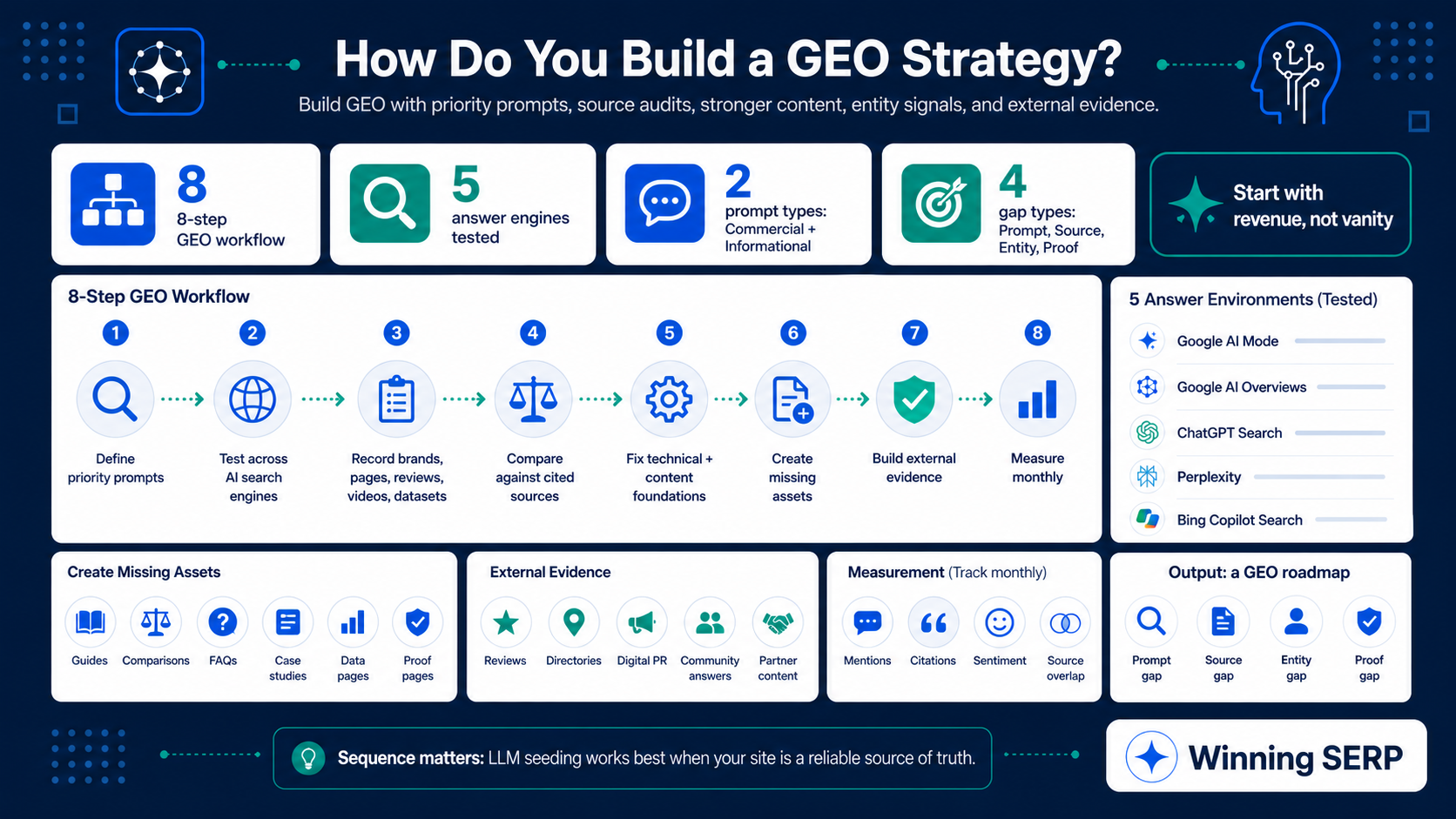
Build a GEO strategy by choosing priority prompts, auditing current answers, mapping cited sources, upgrading owned content, improving entity signals, and creating external evidence. The sequence matters because LLM seeding strategy works best when your own site already gives AI systems a reliable source of truth.
Start with revenue, not vanity. A B2B company might prioritize prompts such as “best technical SEO agency for SaaS migration,” “compare AI SEO agencies,” or “how do I optimize for AI Overviews?” A publisher might prioritize informational prompts where citation visibility can grow authority and subscriptions.
Use this 8-step GEO workflow:
- Define the commercial prompts and informational prompts that matter.
- Test those prompts across Google AI Mode, Google AI Overviews, ChatGPT Search, Perplexity, and Bing Copilot Search.
- Record which brands, pages, domains, reviews, videos, and datasets appear.
- Compare your owned content against the cited sources.
- Fix technical access, indexation, schema, internal links, and content clarity.
- Create missing assets: guides, comparisons, FAQs, case studies, data pages, and proof pages.
- Build external evidence through reviews, directories, digital PR, community answers, and partner content.
- Measure mentions, citations, sentiment, and source overlap monthly.
The output should be a roadmap, not a vague instruction to “optimize for AI.” Every task should map to a prompt gap, source gap, entity gap, or proof gap.
How Should You Research Prompts for GEO?
Research GEO prompts by collecting the real questions users ask before they trust a brand, product, service, or answer. A useful AI search prompts set includes definitions, comparisons, alternatives, best-for queries, pricing questions, risk questions, and implementation questions.
Do not limit research to keyword tools. Prompt behavior is more conversational, more comparative, and more task-oriented than classic keyword behavior. Users ask follow-ups, add constraints, and expect a synthesized response.
For an SEO services company, the prompt set might include:
| Prompt Type | Example | What GEO Should Learn |
|---|---|---|
| Definition | ”What is generative engine optimization?” | Which definitions and sources shape the category |
| Comparison | ”GEO vs SEO for B2B SaaS” | Which tradeoffs users need explained |
| Recommendation | ”Best AI SEO agencies for technical websites” | Which competitors and directories appear |
| Diagnostic | ”Why is my brand not showing in ChatGPT answers?” | Which evidence gaps block inclusion |
| Tactical | ”How do I optimize content for AI Overviews?” | Which steps the answer engine recommends |
| Measurement | ”How do I track AI search visibility?” | Which tools, metrics, and dashboards matter |
Record the prompt, platform, date, answer summary, cited sources, mentioned brands, sentiment, and missing evidence. Repeat the test with variations so you do not make decisions from one unstable answer.
How Do You Optimize Content for Generative Engines?
Optimize content for generative engines by making every section directly answerable, extractable, and credible. A page about GEO should connect to content strategy, SEO content marketing, and ChatGPT for SEO because answer engines need both useful content and workflows that reveal what users ask.
The strongest AI-source pages usually share several traits:
| Content Trait | What It Looks Like | Why It Helps |
|---|---|---|
| Direct answer first | The section answers the heading in the first 1-2 sentences | AI systems can extract the core point quickly |
| Question-led headings | H2s and H3s map to real user questions | The page aligns with prompt behavior |
| Tables and lists | Comparisons, checklists, frameworks, scoring models | Structured content is easier to summarize |
| Examples | Specific situations, industries, tools, prompts | Examples reduce ambiguity |
| Evidence | Sources, data, screenshots, quotes, case studies | Claims become easier to trust |
| Clear entities | Named products, people, services, platforms, and categories | The system can connect concepts accurately |
| Freshness | Current dates, updated facts, recent context | Fast-moving AI topics need recent validation |
Write each paragraph as if it may become a source passage. Avoid vague introductions, inflated claims, and sentences that depend on the reader already knowing the context.
How Should GEO Pages Be Structured?
GEO pages should use question-led headings, concise paragraphs, tables, answer blocks, examples, FAQs, and clear internal links. This structure helps AI answer engines and users scan the same page without forcing either one through a wall of undifferentiated prose.
Use a simple pattern under each major heading:
- Answer the question immediately.
- Explain why it matters.
- Add a table, example, checklist, or framework if the concept has moving parts.
- Connect the section to a related page or source.
- Close with a practical next step.
For example, a section about AI citations should not only say “citations matter.” It should define citation visibility, explain where citations appear, show how to log cited domains, and link to the guide that explains how to rank in AI search.
What Content Formats Work Best for GEO?
The best GEO content formats are definitions, comparison guides, buyer guides, original research, benchmarks, glossaries, FAQs, templates, and evidence-rich service pages. These formats give answer engines reusable source material and help users make decisions.
Prioritize formats by prompt intent:
| Prompt Intent | Best Format | Example Asset |
|---|---|---|
| Learn | Definition guide | What is GEO? |
| Compare | Versus article | GEO vs SEO |
| Decide | Buyer guide | Best AI SEO agencies |
| Validate | Case study | AI Overview citation growth |
| Implement | Checklist | GEO audit checklist |
| Measure | Dashboard guide | AI search visibility tracking |
| Troubleshoot | Diagnostic guide | Why AI answers ignore your brand |
You do not need every format at once. Start with one pillar guide, then build supporting assets around the prompts that have commercial or authority value.
How Do Entity SEO and GEO Work Together?
Entity SEO and GEO work together because generative engines need to understand who or what they are talking about before they can recommend it. A strong brand entity visibility system makes your organization, people, services, products, and expertise easier to recognize.
Entity confusion is a quiet GEO killer. If your company name is inconsistent, your founder profile is thin, your service categories are vague, and your external profiles use outdated positioning, AI systems must resolve uncertainty before they can mention you confidently.
Strengthen these entity elements:
| Entity Element | GEO Question | Optimization Action |
|---|---|---|
| Organization | Who is the brand? | Clear About page, Organization schema, sameAs links |
| People | Who creates or reviews the content? | Author bios, credentials, profiles, expert commentary |
| Services | What does the brand do? | Specific service pages, FAQs, deliverables, proof |
| Products | What does the product offer? | Feature pages, documentation, pricing, comparisons |
| Locations | Where does the brand operate? | Local pages, citations, review profiles, NAP consistency |
| Topics | What expertise does the brand own? | Topic clusters, internal links, original frameworks |
| Evidence | Who confirms the claims? | Reviews, case studies, citations, third-party mentions |
The goal is not to stuff every page with schema. The goal is to make your entity obvious in both human-readable and machine-readable ways.
How Do Mentions, Co-Citations, and Links Affect GEO?
Mentions, co-citations, and links affect GEO because they help answer engines understand which brands, sources, and concepts belong together. A brand with strong third-party evidence and relevant backlinks gives AI systems more corroboration than a brand that only talks about itself.
A backlink is a direct link from another page. A mention names your brand without necessarily linking. A co-citation happens when your brand appears near related entities, competitors, products, or categories. A co-occurrence happens when your brand appears near important topical language.
All four signals can matter:
| Signal | Example | GEO Value |
|---|---|---|
| Link | An industry article links to your AI SEO guide | Direct authority and discoverability |
| Mention | A podcast transcript names your agency | Entity recognition and topical association |
| Co-citation | Your brand appears beside known competitors | Category fit and comparison relevance |
| Co-occurrence | Your brand appears near “AI Overview optimization” | Topic association |
Do not chase low-quality mentions. GEO is trust-sensitive. Spammy directory blasts, fake reviews, and synthetic forum posts can create noise that makes the brand look less reliable.
How Do You Use Schema Markup for GEO?
Use schema markup for GEO by clarifying entities, relationships, and page purpose. Schema supports entity signals and helps search systems understand your organization, article, author, service, product, FAQ, breadcrumb, and local business details.
Schema does not guarantee AI inclusion. Google has said there is no special structured data type required for AI Overviews or AI Mode. Still, structured data can reduce ambiguity, support eligibility for search features, and make the source of truth easier to parse.
For GEO, prioritize:
| Schema Type | Use Case | Important Fields |
|---|---|---|
| Organization | Brand identity | name, url, sameAs, logo, contactPoint |
| Person | Author and expert clarity | name, url, sameAs, knowsAbout, affiliation |
| Article | Editorial content | headline, datePublished, dateModified, author |
| Service | Service pages | serviceType, provider, areaServed, offers |
| Product | SaaS and ecommerce | name, brand, offers, aggregateRating, reviews |
| FAQPage | Real question-answer pages | question, acceptedAnswer |
| BreadcrumbList | Site hierarchy | itemListElement |
Keep markup consistent with visible content. If the page does not clearly state the claim, schema should not invent it.
How Do You Make GEO Technical Enough to Work?
Make GEO technical enough to work by ensuring AI-relevant pages are crawlable, indexable, internally linked, rendered correctly, fast enough, and accessible without unnecessary friction. This is where a crawl-based audit protects GEO from turning into pure content theory.
Technical failures can remove your content from consideration before quality matters. A blocked robots.txt rule, noindex tag, canonical mistake, broken internal link, script-rendered article body, or missing sitemap entry can stop a strong page from being discovered or trusted.
Audit these items:
| Technical Check | Why It Matters |
|---|---|
| Indexability | Search-backed AI systems often depend on indexed content |
| Crawl access | Blocked content cannot become retrievable evidence |
| Internal links | Topic relationships and discovery paths become clearer |
| Rendering | AI and search systems need the actual article body |
| Snippet controls | Restrictive preview settings may limit source usefulness |
| Page speed | Slow pages hurt users and can create crawl inefficiency |
| Structured data validation | Broken markup weakens entity clarity |
| Log files | AI crawler and search crawler behavior becomes measurable |
Technical GEO is not about creating a new file for every AI crawler. It is about making your best evidence available, clear, and consistent.
How Do You Measure GEO Performance?
Measure GEO performance with a mix of prompt tracking, citation tracking, source overlap, referral analysis, brand demand, sentiment review, and traditional SEO metrics. No single dashboard fully captures answer engine visibility, so use a blended measurement model.
Start with a prompt visibility sheet:
| Metric | How To Track It | What It Tells You |
|---|---|---|
| Brand mentions | Manual tests or AI visibility tools | Whether the brand appears in answers |
| Source citations | Record linked domains and URLs | Which pages support generated answers |
| Source overlap | Compare cited sources across platforms | Which publishers influence the category |
| Sentiment | Classify answer language as positive, neutral, negative, or inaccurate | How the brand is framed |
| Prompt coverage | Count prompts with useful brand presence | How much of the buyer journey you cover |
| Referral traffic | Analytics from Perplexity, ChatGPT, Copilot, and other sources | Whether AI answers send visits |
| Branded search | Google Search Console and rank tools | Whether AI exposure creates later demand |
| Conversion assists | CRM and analytics notes | Whether AI-influenced users become pipeline |
Review results monthly. AI answers can vary by platform, user context, geography, freshness, and retrieval source. One test is a screenshot. A repeated prompt set is a dataset.
Which Tools Help Track GEO?
GEO tracking tools can help monitor AI mentions, citations, sentiment, and competitors, but manual testing remains essential. Tools change quickly, and every platform has different access limits, so connect automated monitoring with a stable prompt set rather than outsourcing judgment.
Useful tool categories include:
| Tool Category | What It Helps With |
|---|---|
| AI visibility platforms | Mentions, citations, competitors, sentiment, prompt coverage |
| Rank trackers | SERP features, AI Overview presence, keyword changes |
| Analytics tools | Referral traffic from AI sources |
| Google Search Console | Query impressions, branded demand, page performance |
| Log analyzers | AI crawler and search crawler behavior |
| Brand monitoring | Mentions across web, news, communities, and social platforms |
| Review tools | Sentiment, review quality, category language |
Avoid overreacting to one tool score. Treat tools as sensors. The strategy still comes from understanding why certain sources and brands appear.
What Does a GEO Audit Include?
A GEO audit includes prompt testing, AI answer analysis, content quality review, technical SEO review, entity audit, schema review, internal link audit, source coverage map, competitor source map, and measurement plan. It turns AI SEO strategy into prioritized work.
Use this audit template:
| Audit Area | Questions To Answer | Output |
|---|---|---|
| Prompt set | Which prompts influence discovery and revenue? | 30-100 priority prompts |
| Current visibility | Where are we mentioned or cited now? | Mention and citation baseline |
| Competitor visibility | Which brands appear instead of us? | Competitor answer map |
| Source overlap | Which domains repeat across answers? | Outreach and seeding targets |
| Content gaps | Which questions do we fail to answer well? | New or refreshed content briefs |
| Technical access | Can systems crawl and render key pages? | Technical fixes |
| Entity clarity | Is the brand described consistently? | Entity cleanup plan |
| Proof gaps | What claims lack evidence? | Case study, review, and data tasks |
| Measurement | How will we track progress? | Monthly GEO dashboard |
The best audit produces fewer priorities than expected. GEO can become sprawling if every prompt, platform, and source gets equal attention. Start with prompts that can influence revenue, authority, or category ownership.
What Are the Most Common GEO Mistakes?
The most common GEO mistakes are chasing hacks, ignoring SEO basics, publishing vague AI content, neglecting external evidence, and measuring only direct clicks. These mistakes usually happen when teams treat GEO as a novelty instead of an extension of AI search strategy.
Watch for these failure patterns:
| Mistake | Why It Hurts | Better Move |
|---|---|---|
| Creating “AI-only” pages with thin content | Answer engines need useful source material | Build genuinely helpful topic pages |
| Ignoring technical SEO | Content may not be retrievable | Fix crawl, indexation, rendering, and links |
| Overusing exact-match anchors | Internal links look forced | Use natural phrase-level anchors |
| Faking reviews or comments | Trust signals become liabilities | Earn real third-party proof |
| Publishing without sources | Claims lack corroboration | Add data, examples, and citations |
| Tracking one prompt once | AI answers vary | Build a repeated prompt baseline |
| Optimizing only your website | AI systems inspect external sources | Build distributed evidence |
| Treating schema as magic | Markup cannot rescue weak content | Align schema with clear visible content |
The deeper issue is impatience. GEO compounds through cleaner content, stronger entities, better source coverage, and repeated measurement. Shortcuts usually create fragile signals.
How Should Different Teams Use GEO?
Different teams should use GEO according to the evidence they control. SEO teams manage crawlability, content, internal links, and measurement, while PR, product, customer success, and brand teams strengthen the sources that generative AI search may consult.
GEO becomes easier when ownership is clear:
| Team | GEO Responsibility |
|---|---|
| SEO | Technical access, topic clusters, internal links, schema, AI answer tracking |
| Content | Definitions, comparisons, FAQs, original research, refreshes, proof pages |
| PR | Expert quotes, editorial mentions, interviews, category citations |
| Customer success | Reviews, testimonials, case studies, customer language |
| Product | Documentation, changelogs, pricing clarity, feature accuracy |
| Brand | Entity consistency, positioning, profiles, social proof |
| Sales | Objection patterns, buyer questions, competitor comparisons |
| Analytics | Attribution, dashboards, assisted conversion reporting |
A GEO roadmap should assign each task to the team that can actually change the signal. SEO can recommend review quality improvements, but customer success may need to execute them. PR can earn mentions, but SEO should guide which categories and prompts matter.
How Do GEO, AEO, and LLMO Compare?
GEO, AEO, and LLMO overlap, but they emphasize different parts of AI search optimization. GEO focuses on generative answer environments, AEO often focuses on answer engine optimization, and LLMO usually focuses on visibility in large language model outputs.
In practice, the work converges:
| Term | Primary Focus | Practical Work |
|---|---|---|
| GEO | Generative engine answers | Content, citations, entity signals, source coverage |
| AEO | Answer engine optimization | Direct answers, structured content, featured responses, AI answers |
| LLMO | Large language model optimization | Model-visible evidence, prompt tracking, third-party sources |
| AI SEO | Search strategy for AI-influenced discovery | SEO fundamentals plus AI search, entities, and measurement |
Do not spend too much time arguing over labels. The buyer does not care whether the tactic is called GEO or AEO. They care whether your brand appears accurately when an AI system answers the question that matters.
What Is a Practical GEO Roadmap?
A practical GEO roadmap starts with one topic cluster, one prompt set, and one evidence system. For many brands, that means pairing a GEO pillar page with Google AI Overviews, entity clarity, and LLM seeding work.
Here is a 90-day roadmap:
| Timeframe | Focus | Deliverables |
|---|---|---|
| Days 1-15 | Baseline | Prompt set, answer captures, cited source list, competitor map |
| Days 16-30 | Technical and entity fixes | Crawl fixes, schema updates, profile cleanup, internal link improvements |
| Days 31-50 | Owned content | Pillar guide, comparison page, FAQ refresh, proof page, service page updates |
| Days 51-70 | External evidence | Review requests, directory updates, expert quotes, digital PR targets |
| Days 71-85 | Measurement | Dashboard, prompt retests, citation changes, sentiment review |
| Days 86-90 | Next cycle | Prioritized refreshes, outreach tasks, new content briefs |
The roadmap should feel boring in the best way: clear tasks, measurable gaps, real sources, and steady iteration. GEO is not one launch. It is an evidence flywheel.
How Can You Start With GEO This Week?
Start GEO this week by testing priority prompts, recording the answers, and turning the first evidence gaps into owned content, internal link, entity, and source tasks.
Interactive scorecard
GEO First-Week Readiness
Check what you can complete this week. The score shows whether you have a real GEO starting system or only a loose idea.
Use the scorecard as a first-week operating plan. A low score means the prompt baseline is still missing; a strong score means you are ready to retest the same prompts in 30 days and compare movement.
Is GEO Worth It?
GEO is worth it for brands whose buyers use AI systems to research, compare, or choose options. It is especially important for B2B services, SaaS, ecommerce, publishers, local services, healthcare-adjacent education, finance-adjacent education, and any category where users ask complex questions before converting.
The honest answer is that GEO will not produce clean attribution for every win. Some value will appear as citations. Some will appear as referral traffic. Some will appear as branded search. Some will appear when a sales lead says they saw your name in an AI answer and then looked you up.
That does not make GEO soft. It makes measurement more layered. Search has always influenced decisions before the final click. Generative search simply makes that influence more compressed, conversational, and source-dependent.
Brands that win GEO will not be the ones that shout “AI” the loudest. They will be the ones with clear entities, useful content, credible proof, technical access, strong internal links, and enough external corroboration for answer engines to trust them.
What Does GEO Look Like by Industry?
GEO looks different by industry because answer engines retrieve different evidence for different decisions. A SaaS buyer may need review platforms, documentation, integrations, pricing pages, and comparison articles, while a local service buyer may need reviews, local citations, service-area pages, and recent community recommendations.
That is why a generic GEO checklist can only take you so far. The work has to match the sources, entities, and trust signals that matter in your category. The same prompt format can produce very different source patterns across industries.
| Industry | Common AI Search Prompts | High-Value GEO Evidence |
|---|---|---|
| B2B SaaS | ”Best CRM for agencies,” “compare HubSpot alternatives” | Review profiles, integrations, documentation, pricing pages, comparison guides |
| Professional services | ”Best SEO agency for AI search,” “technical SEO consultant near me” | Service pages, case studies, expert bios, Clutch-style profiles, third-party mentions |
| Ecommerce | ”Best running shoes for flat feet,” “compare OLED vs QLED” | Product data, buying guides, reviews, videos, category filters, structured product markup |
| Local services | ”Emergency plumber open now,” “best dentist for implants” | Google Business Profile, local citations, reviews, location pages, service proof |
| Publishers | ”What does this policy mean?” “latest AI search stats” | Original reporting, source citations, author expertise, freshness, topical authority |
| Education | ”Best way to learn technical SEO,” “course vs bootcamp” | Course pages, instructor credentials, syllabi, reviews, outcomes, comparison content |
For B2B SaaS, GEO often becomes a review and comparison problem. If answer engines repeatedly cite G2, Capterra, Reddit, product documentation, and “best software” lists, then your own blog is only one part of the evidence environment.
For ecommerce, GEO becomes a product understanding problem. AI systems need attributes, variants, availability, reviews, prices, use cases, and buying criteria. Thin product descriptions rarely give enough source material for a useful generated answer, especially as agentic commerce moves AI shopping from recommendations toward product comparison and checkout readiness.
For local services, GEO becomes a trust and proximity problem. The system needs to understand the business category, service area, opening hours, reviews, credentials, images, and local relevance. A polished homepage cannot compensate for inconsistent local profiles.
How Should SaaS Companies Approach GEO?
SaaS companies should approach GEO by making their product category, use cases, integrations, pricing, proof, and alternatives extremely clear. AI systems often answer SaaS prompts by comparing options, summarizing reviews, and citing documentation, so AI source coverage matters as much as blog depth.
Start by mapping the buying questions:
- What problem does the product solve?
- Which teams use it?
- Which alternatives do buyers compare?
- Which integrations matter?
- What does it cost?
- What are the strongest and weakest review themes?
- Which use cases have proof?
- What implementation risks should buyers know?
Then map those questions to assets:
| Buyer Question | GEO Asset | Evidence Standard |
|---|---|---|
| What does it do? | Product and use-case pages | Clear features, outcomes, screenshots, examples |
| Who is it for? | Persona and industry pages | Specific roles, workflows, constraints |
| How does it compare? | Comparison pages | Fair criteria, tradeoffs, migration notes |
| Is it trusted? | Reviews and case studies | Named customers, measurable outcomes, detailed language |
| How does it integrate? | Documentation | Public docs, examples, API clarity |
| What does it cost? | Pricing page | Transparent tiers, limits, FAQs |
SaaS GEO fails when every page says the product is “all-in-one” and “AI-powered” without giving the model concrete attributes. Give answer engines the facts they need to make a fair comparison.
How Should Service Businesses Approach GEO?
Service businesses should approach GEO by proving expertise, fit, process, outcomes, and trust. A service buyer does not only ask “who ranks?” They ask who understands the problem, who has done similar work, who is credible, and who can explain the tradeoffs.
For an SEO agency, a strong GEO footprint connects AI SEO services, technical audit proof, content strategy, author expertise, client examples, reviews, and clear category positioning. That is where brand authority in AI search becomes practical: the goal is to make the agency easy to identify as a credible option for specific prompts, not just broad “SEO agency” searches.
Important service-business assets include:
| Asset | GEO Role |
|---|---|
| Service pages | Define commercial capabilities and deliverables |
| Case studies | Prove outcomes and context |
| About page | Clarify people, experience, location, and credibility |
| Author pages | Connect expertise to content |
| Reviews | Show customer language, sentiment, and use cases |
| Comparison pages | Explain fit against alternatives |
| Process pages | Reduce uncertainty about how the work happens |
| FAQ sections | Answer objections and buying questions |
Service GEO also depends on clean entity relationships. If the founder, brand, services, location, and proof sources are disconnected, AI systems may struggle to understand why the business belongs in a recommendation answer.
How Should Publishers Approach GEO?
Publishers should approach GEO by becoming citation-worthy, not only traffic-hungry. AI answers can summarize publisher content, cite original reporting, and reduce some clicks, so publishers need strong topical authority, original data, clear sourcing, and memorable editorial value.
A publisher page is more likely to support AI answers when it offers something extractable and defensible: original statistics, expert quotes, timelines, definitions, comparison tables, methodology notes, or reporting that other pages do not simply repeat.
For publishers, GEO priorities include:
| Priority | Why It Matters |
|---|---|
| Original reporting | Gives AI systems a reason to cite the source |
| Author expertise | Helps distinguish credible analysis from commodity summaries |
| Clear dates | Fast-changing topics need freshness signals |
| Methodology | Data claims become easier to trust |
| Topic hubs | Internal links show depth and relationships |
| Source transparency | Readers and systems can verify claims |
| Distinct analysis | The answer has something unique to reuse |
Commodity articles are vulnerable in generated answers because AI systems can synthesize generic facts from many sources. Original work, better explanations, and clear data tables give publishers a stronger reason to be used.
How Do You Build a GEO Content Hub?
Build a GEO content hub by connecting one pillar page, supporting explainers, comparison pages, service pages, data assets, and proof pages. A hub helps users navigate the topic and helps answer engines understand relationships across your AI and SEO strategy.
For the GEO topic, a practical hub could include:
| Hub Asset | Purpose | Internal Link Target |
|---|---|---|
| GEO pillar guide | Defines the category and roadmap | This article |
| AI search ranking guide | Explains visibility mechanics | /how-to-rank-in-ai-search/ |
| LLM seeding guide | Explains external evidence | /llm-seeding/ |
| Entity SEO guide | Explains brand understanding | /entity-seo-how-to-build-digital-brand-visibility-in-ai-search/ |
| AI Overviews guide | Explains Google-specific source selection | /ai-overviews-what-they-are-and-how-to-optimize-for-them/ |
| Prompt research guide | Explains testing and measurement inputs | /how-to-do-prompt-research-for-ai-seo/ |
| AI SEO service page | Converts strategy into a commercial offer | /seo/ai-seo-services/ |
Internal links should be contextual and phrase-level. A paragraph about external evidence should link to LLM seeding. A paragraph about entity clarity should link to entity SEO. A paragraph about Google Search should link to AI Overviews. This creates a knowledge base rather than a loose set of articles.
The hub should also avoid cannibalization. The GEO pillar explains the full system. The AI Overviews guide should focus on Google. The LLM seeding guide should focus on external evidence. The prompt research guide should focus on testing. Each page needs a distinct job.
How Do You Refresh Existing Content for GEO?
Refresh existing content for GEO by adding direct answers, clearer entities, comparison tables, cited sources, updated examples, and internal links to related assets. You do not need to rewrite every page from scratch; often the best first move is improving pages that already rank or already earn impressions.
Use this refresh process:
- Choose pages that rank, convert, or support important prompts.
- Test related AI prompts and record missing information.
- Add a direct answer near the top of each important section.
- Replace vague paragraphs with specific examples, data, or tables.
- Add source citations where claims need support.
- Clarify entities, audiences, services, tools, and relationships.
- Add contextual internal links to the relevant cluster pages.
- Update schema and dates where appropriate.
- Retest the same prompt set after indexing and recrawling.
This approach is efficient because older pages may already have authority. A refreshed page with stronger structure and evidence can become better source material faster than a brand-new page with no signals.
Do not refresh only for AI. Refresh for users who need better decisions. When the page becomes easier to read, compare, verify, and act on, it becomes more useful to search engines and answer engines at the same time.
How Do You Handle External Sources in a GEO Program?
Handle external sources by mapping which domains answer engines repeatedly cite, then improving your presence where it is editorially legitimate. This is the practical side of answer engine evidence and digital PR.
External sources usually fall into several buckets:
| Source Type | Examples | GEO Action |
|---|---|---|
| Review platforms | G2, Clutch, Trustpilot, Google reviews | Improve profile completeness and review quality |
| Editorial lists | ”Best tools,” “top agencies,” buyer guides | Pitch useful updates, data, expert input |
| Communities | Reddit, forums, LinkedIn discussions | Participate genuinely, answer questions, avoid spam |
| Marketplaces | App stores, plugin directories, integration pages | Clarify categories, screenshots, descriptions |
| Documentation | Public docs, APIs, changelogs | Keep current and crawlable |
| Video platforms | YouTube, webinars, demos | Add transcripts, descriptions, chapters |
| News and analysis | Interviews, quotes, studies | Contribute expertise and original data |
The wrong way is to blast low-quality submissions everywhere. The right way is to identify sources that already influence the answer and improve the quality of your evidence in those places.
For example, if three AI platforms cite the same buyer guide for your category, that guide matters. If a Reddit thread appears repeatedly, the questions in that thread should shape your content and community work. If documentation keeps appearing for technical prompts, your docs need to be accurate and easy to parse.
How Do You Avoid GEO Spam?
Avoid GEO spam by optimizing for evidence quality instead of artificial signal volume. Answer engines are trust-sensitive, and low-quality mentions, fake reviews, doorway pages, and synthetic comments can damage the credibility GEO is supposed to build.
Spammy GEO often looks like this:
| Spam Pattern | Why It Fails |
|---|---|
| Fake review campaigns | They create trust and compliance risk |
| AI-generated forum stuffing | Communities remove it and users distrust it |
| Thin “best” pages | They add no real comparison value |
| Exact-match mention blasts | They look unnatural and rarely influence trusted sources |
| Schema claims not visible on the page | They create inconsistency |
| Duplicate pages for every prompt variation | They dilute quality and crawl focus |
Good GEO looks more patient. It improves the truth: better pages, better proof, better reviews, better citations, better data, better participation, and better measurement.
If a tactic would embarrass the brand if a prospect found it, do not use it. GEO is partly about becoming legible to machines, but the signals still come from human trust.
How Does GEO Change Internal Linking?
GEO changes internal linking by making relationship clarity more important. Internal links help search engines, users, and AI systems understand which pages define a concept, which pages support it, and which pages convert the user into a service or product conversation.
An internal link for GEO should do one of three jobs:
- Define a related concept.
- Support a deeper implementation step.
- Connect an informational page to a commercial or proof page.
For example, this article links to optimize for AI Overviews guidance when the topic is Google-specific, to AI SEO prompt research when the topic is testing, and to the site audit process when the topic is crawlability.
That link pattern tells a cleaner story. GEO is the system, AI Overviews are one surface, prompt research is the diagnostic layer, technical SEO is the accessibility layer, and AI SEO services are the commercial implementation path.
Avoid generic “read more” links. Use natural anchors that describe the destination. The link should make sense even if the reader only scans the sentence.
What Should You Report to Executives About GEO?
Report GEO to executives as visibility, risk, and evidence quality, not as a single ranking metric. Leaders need to know whether the brand appears in AI answers, whether competitors appear instead, whether the brand is described accurately, and which proof gaps block progress.
A useful executive report includes:
| Report Section | What To Show |
|---|---|
| Visibility baseline | Percentage of priority prompts where the brand appears |
| Citation baseline | URLs and external sources cited for important prompts |
| Competitor presence | Brands that appear most often and why |
| Accuracy risks | Wrong descriptions, outdated pricing, missing services |
| Source gaps | Domains and content types the brand lacks |
| Action plan | Owned content, technical fixes, external evidence, review work |
| Business signal | Branded search changes, referral traffic, assisted leads |
Keep the narrative clear: “AI systems currently mention us in 6 of 40 priority prompts. Competitor A appears in 18. The difference is not one keyword. They have stronger comparison mentions, clearer review profiles, and a better documented use-case library.”
That kind of reporting helps executives fund the right work. GEO is easier to support when it looks like a visibility and trust problem, not a vague request for more content.
What Is the Future of GEO?
The future of GEO is a more connected search system where users move between results pages, AI summaries, conversational assistants, vertical tools, and agentic workflows. As agentic search grows, AI systems may not only answer questions; they may compare vendors, inspect sources, summarize reviews, and recommend next actions.
That future makes evidence quality more important. An agentic system can decompose one prompt into many hidden checks: category fit, technical proof, pricing, reviews, service area, expertise, freshness, and trust. A brand with disconnected or shallow evidence will fail more of those checks.
GEO will also become less separable from normal SEO. Search engines are adding AI layers. AI assistants are adding web retrieval. Buyers are switching surfaces mid-journey. The same content, entity, technical, and trust systems will support all of them.
The durable strategy is not to chase every new AI product. It is to build a brand and website that can be found, understood, verified, cited, and recommended wherever the user asks.
GEO FAQ
These are the questions teams usually ask when GEO moves from a concept into planning, budgeting, and execution. The short version: GEO is not a separate universe, but it does require new research habits, broader evidence, and more careful measurement than classic page-level SEO.
Is GEO the Same as AI SEO?
GEO and AI SEO overlap, but they are not perfectly identical. AI SEO is the broader search strategy for AI-influenced discovery, while GEO focuses specifically on how brands and content appear inside generated answers.
Think of AI SEO as the umbrella. It includes traditional SEO fundamentals, AI search surfaces, prompt research, entity optimization, technical accessibility, and measurement. GEO sits inside that umbrella as the practice of becoming visible, cited, and trusted in generative answer environments.
For most teams, the distinction is useful but not worth overcomplicating. If your work improves crawlability, answer quality, entity clarity, source coverage, and trust, it supports both AI SEO and GEO.
Can Small Brands Win GEO?
Small brands can win GEO when they focus on specific prompts, specific audiences, and specific evidence gaps. A small brand usually cannot dominate every broad category answer, but it can become visible for niche, local, technical, or high-intent questions where its proof is unusually clear.
For example, a small technical SEO consultancy may struggle to appear for “best SEO agency” but can compete for “technical SEO consultant for SaaS migration,” “crawl budget audit for ecommerce,” or “AI search visibility audit for B2B websites.”
The advantage is focus. Big brands often have more authority, but smaller brands can publish clearer explanations, better case studies, sharper comparison pages, and more specific proof for neglected prompts.
How Long Does GEO Take?
GEO usually takes weeks to baseline and months to compound. You can complete the first prompt audit, source map, and content refresh in a few weeks, but the external evidence layer takes longer because reviews, mentions, citations, and third-party profiles do not change instantly.
Expect three phases:
| Phase | Timeline | What Changes |
|---|---|---|
| Baseline | 1-3 weeks | Prompt set, answer captures, cited source map, technical gaps |
| Foundation | 1-3 months | Content updates, schema cleanup, internal links, entity profiles |
| Compounding | 3-12 months | Reviews, PR, citations, comparison presence, source authority |
The timeline depends on the starting point. A site with strong SEO, clear services, and existing third-party proof can move faster. A site with thin content, inconsistent profiles, and weak technical health needs more groundwork.
Should GEO Content Be Written Differently?
GEO content should be written more clearly, not more mechanically. The goal is to make the answer, context, evidence, and next step easy to extract without making the article sound like it was written only for a machine.
Use direct answers under headings. Add tables when concepts need comparison. Include examples when definitions could be vague. Cite sources when claims need support. Name entities precisely. Keep paragraphs short enough that a reader can scan them and an answer system can isolate the useful passage.
The worst GEO content sounds like keyword stuffing with new labels. The best GEO content feels like a senior practitioner wrote the source material an AI answer would be lucky to cite.
Do You Need Special Schema for GEO?
You do not need a special GEO schema type. Use the structured data types that already fit the page: Organization, Person, Article, Service, Product, FAQPage, BreadcrumbList, LocalBusiness, and other relevant Schema.org types.
The important rule is consistency. Schema should clarify visible content, not invent claims that users cannot see on the page. If your article says one author wrote the guide, your Article schema should not imply a different author. If your service page describes one offer, your Service schema should match that offer.
Structured data helps most when it supports entity clarity. It tells search systems what the page is, who created it, who the organization is, and how key relationships fit together.
Does GEO Require Blocking or Allowing AI Crawlers?
GEO does not automatically require a new crawler policy. Most businesses that want visibility should make their public evidence crawlable by major search engines and relevant AI systems, while protecting private, gated, paid, or sensitive content according to their business model.
Crawler policy is a strategic decision. Publishers may have different licensing, paywall, and AI training concerns than service businesses. Ecommerce sites may want product pages discoverable but not want internal search pages crawled. SaaS companies may want documentation indexed but not private support content exposed.
The baseline is simple: do not accidentally block the pages you expect AI-powered search systems to find. Review robots.txt, meta robots, canonical tags, preview controls, and rendering before assuming GEO is a content-only problem.
Can GEO Increase Traffic?
GEO can increase traffic, but not every GEO win produces a direct click. Some AI answers cite sources and send referral visits. Some mention brands without links. Some influence users who later search the brand directly. Some support sales conversations because prospects arrive with more trust.
Measure all of these signals:
- AI referral traffic.
- Branded search growth.
- Citation appearances.
- Mention frequency.
- Assisted conversions.
- Sales-call source notes.
- Review and profile engagement.
- Organic rankings for related topics.
If leadership only accepts last-click organic sessions as proof, GEO will look weaker than it is. The better view is influence across discovery, consideration, and validation.
What Should You Do if AI Answers Describe Your Brand Wrong?
If AI answers describe your brand wrong, fix the source environment before blaming the model. Wrong answers often come from outdated profiles, thin service pages, old third-party articles, inconsistent descriptions, missing schema, vague About pages, or review language that does not match current positioning.
Use a correction workflow:
- Save the wrong answer with date, platform, prompt, and screenshots.
- Identify sources cited or likely retrieved.
- Check your own pages for ambiguity.
- Update the canonical source of truth first.
- Update external profiles and review responses where possible.
- Publish clarifying content if the misconception is common.
- Retest the prompt over time.
You cannot force every AI system to update immediately. You can make the web less confusing so the next retrieval pass has better evidence.
What Is the First GEO Hire or Role?
The first GEO role should usually be an SEO strategist who understands content, technical SEO, entities, digital PR, and analytics. GEO touches too many surfaces for a pure writer, pure PR specialist, or pure technical SEO to own alone without coordination.
In a small team, one SEO lead can run the baseline, create briefs, coordinate content updates, and guide external evidence work. In a larger team, GEO becomes a cross-functional program with SEO, content, PR, product marketing, customer success, and analytics involved.
The role needs practical judgment. GEO is still emerging, so the best operator can test prompts, inspect sources, reason from evidence, and avoid overclaiming what any tool can measure.