







AI Overviews are Google Search’s AI-generated summaries that appear for some queries when Google believes a synthesized answer can help users understand the topic faster. They sit inside Google Search, use Google’s systems to generate an answer, and include links that help users explore supporting sources. Strong GEO content makes those supporting sources clearer, deeper, and easier to reuse.
You do not optimize for AI Overviews with a secret tag, an AI-specific file, or a special schema type. Google’s own Search Central guidance says the same SEO fundamentals still apply: make pages crawlable, indexable, snippet-eligible, helpful, reliable, technically accessible, internally linked, and easy to understand.
The practical difference is the bar. AI Overviews reward pages that can be used as source material. A page needs to answer the question clearly, explain the context, support claims, show expertise, and connect with the rest of your topic cluster.
That makes LLM-friendly content a practical advantage: direct answers, semantic headings, tables, captions, and clean source code all help a page become easier to extract.
This guide explains what AI Overviews are, how they work, how they differ from AI Mode and featured snippets, and how to optimize for them without chasing myths.
What Are AI Overviews?
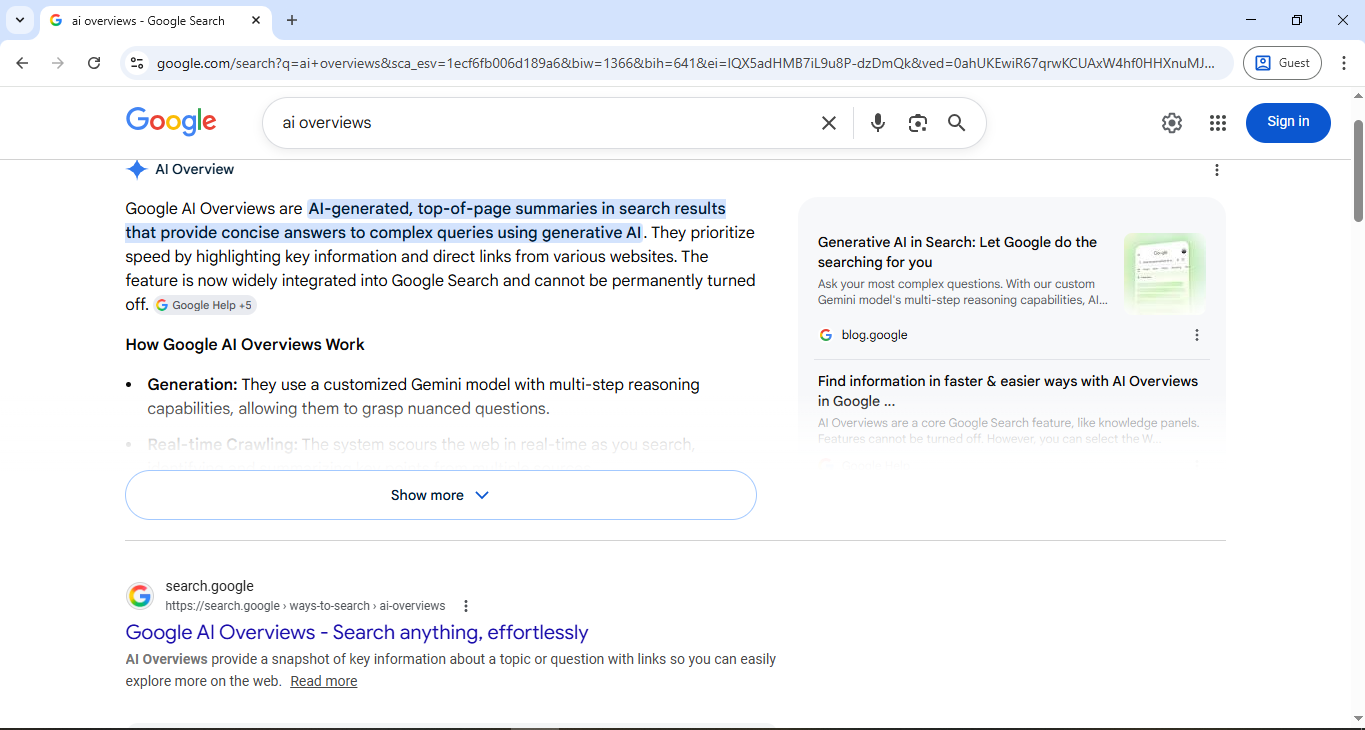
AI Overviews are AI-generated summaries in Google Search that help users get the gist of a query faster and explore supporting links. They appear when Google’s systems decide an AI answer adds value beyond the regular search results.
In a classic results page, Google may show organic links, ads, featured snippets, People Also Ask boxes, images, videos, local packs, shopping results, and other SERP features. AI Overviews add another layer: a synthesized answer that can pull together information from multiple sources.
Google describes AI Overviews as a way to help people understand complicated topics or questions more quickly. The experience is designed as a starting point, not a full replacement for the web. Users can read the summary, click supporting links, and continue exploring.
For SEO teams, that means AI Overviews are not just a ranking position. They are a source-selection environment. Google may surface a page because it supports one part of the generated answer, even if the user’s query is broader than one traditional keyword.
How Do AI Overviews Work?
AI Overviews work by using Google’s AI systems with information retrieval from the web and other Search systems. Google may use a technique called query fan-out, where the system issues multiple related searches across subtopics and data sources to build a better response.
That matters because one user query can create several hidden information needs.
For example, a query such as “how do AI Overviews affect ecommerce SEO?” may involve:
- What AI Overviews are.
- How ecommerce SERPs changed.
- Product information quality.
- Merchant Center data.
- Review and pricing visibility.
- Structured data.
- Internal linking and category pages.
- Measurement in Google Search Console.
Your page may not need to answer every subtopic to be useful. But it needs to be clear enough that Google’s systems can identify which part of the response it supports.
That is why concise headings, clear definitions, structured tables, crawlable body text, accurate schema, and strong internal links matter. They help both users and search systems understand the role of the page.
How Are AI Overviews Different From AI Mode?
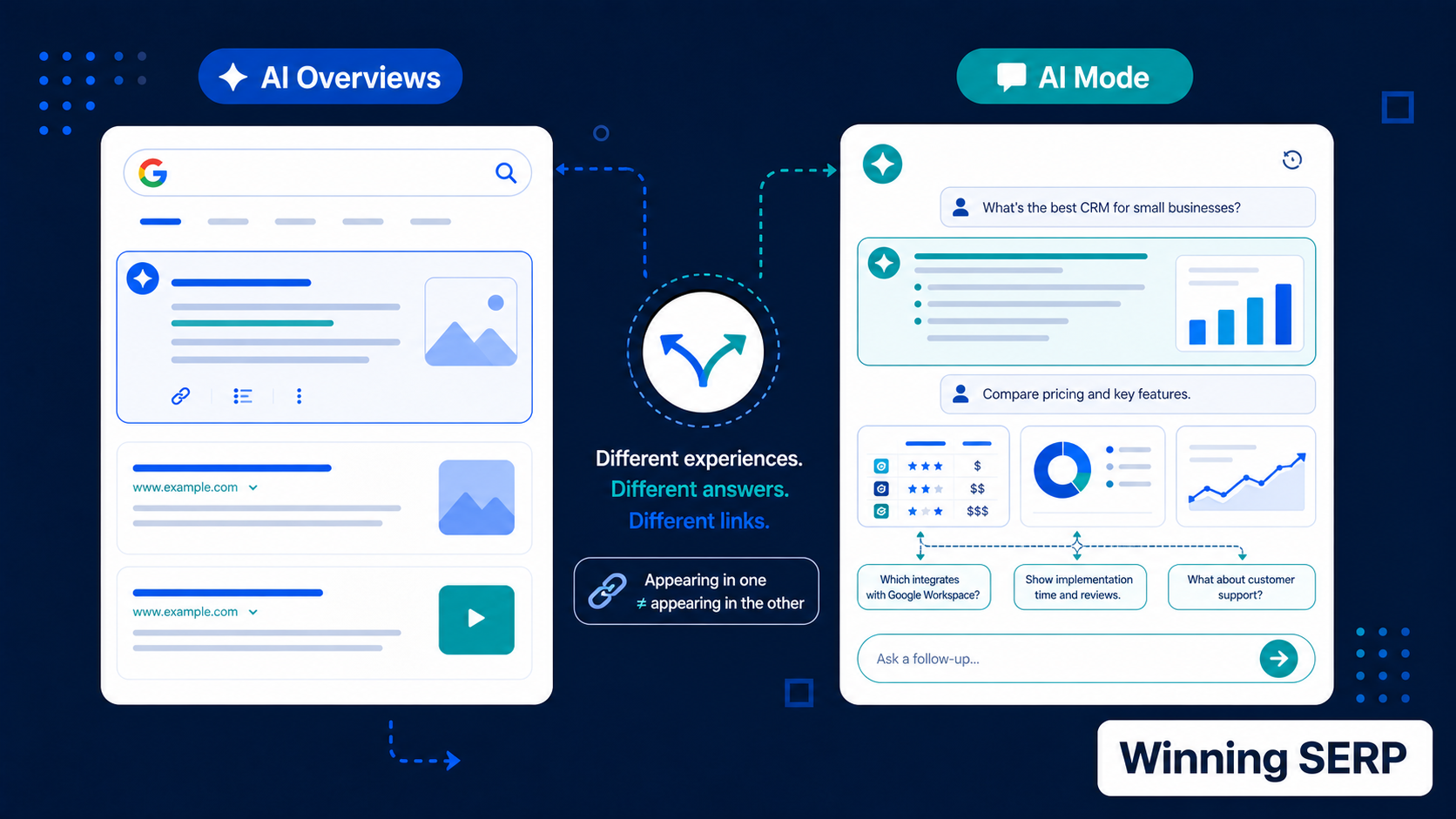
AI Overviews are AI-generated summaries that appear on some Google Search results pages. AI Mode is a more conversational Search experience where users can ask more complex questions, continue with follow-ups, and explore deeper AI-powered responses.
Google says AI Overviews and AI Mode may use different models and techniques, so the responses and links they show can vary. This is important: appearing in an AI Overview does not guarantee appearing in AI Mode, and the reverse is also true.
Think of the difference this way:
| Feature | AI Overviews | AI Mode |
|---|---|---|
| User behavior | Query starts in regular Google Search | User enters a more conversational AI Search flow |
| Trigger | Appears only when Google decides it is additive | User intentionally uses AI Mode |
| Interaction | Summary with links and exploration paths | Follow-up questions and deeper conversation |
| SEO implication | Source selection inside classic SERP context | Source selection inside conversational search context |
| Optimization | Same Search fundamentals | Same Search fundamentals plus prompt testing |
For brands, both belong in a broader AI search visibility strategy. You need pages that work for classic Google Search, AI Overviews, AI Mode, and other answer systems.
How Are AI Overviews Different From Featured Snippets?
AI Overviews are generated summaries that can synthesize information from multiple sources. Featured snippets usually extract or display a concise answer from one source.
A featured snippet might pull a definition, list, table, or paragraph from a page. An AI Overview can combine multiple pieces of information into a summary, then show supporting links.
That difference changes how you think about optimization.
For featured snippets, the target is often a concise answer format. For AI Overviews, the target is source usefulness. Your page may support the overview because it provides a clear explanation, original data, a definition, a process, a comparison table, a visual, or a well-structured answer to one subquestion.
Still, the practical overlap is large:
| Optimization Area | Featured Snippets | AI Overviews |
|---|---|---|
| Direct answers | Important | Important |
| Clear headings | Important | Important |
| Tables and lists | Helpful | Helpful |
| Source credibility | Helpful | Critical |
| Broader context | Useful | More important |
| Internal links | Useful | Important for topic relationships |
| Entity clarity | Useful | Very important |
If your content is vague, unsupported, or hard to parse, it becomes harder for both formats to use.
Can You Optimize Directly for AI Overviews?
You can optimize for AI Overviews indirectly by improving your pages for Google Search and making them useful as supporting sources. You cannot force inclusion with special markup.
Google’s Search Central documentation is explicit: there are no additional technical requirements for AI Overviews or AI Mode beyond being indexed and eligible to appear in Search with a snippet. Google also says there is no special schema.org structured data required for AI features.
That means the right question is not “What AI Overview hack should I use?” The right question is “Would Google’s systems trust this page as a useful source for the answer?”
Useful optimization work includes:
- Allowing Googlebot to crawl important pages.
- Making pages indexable and snippet-eligible.
- Publishing helpful, reliable, people-first content.
- Using internal links so important pages are discoverable.
- Keeping important content in crawlable text.
- Supporting content with images and videos where useful.
- Making structured data match visible page content.
- Keeping Merchant Center and Business Profile data accurate when relevant.
This is not glamorous. It is also why AI Overviews expose weak SEO systems quickly.
What Are the Technical Requirements for AI Overviews?
The technical requirements are the standard Google Search requirements: the page needs to be crawlable, indexable, and eligible to appear with a snippet. Google says there are no additional technical requirements for AI Overviews or AI Mode.
Start with a technical checklist:
| Technical Check | Why It Matters |
|---|---|
| Robots.txt allows crawling | Googlebot needs access to the page |
| Page is indexable | No accidental noindex or canonical confusion |
| Snippet controls allow previews | Restrictive snippet controls can limit display |
| Important content is in HTML text | AI systems need extractable content |
| Internal links point to key pages | Google needs discovery paths |
| Page renders correctly | Important content should not disappear after rendering |
| Structured data is valid | Schema should support visible content |
| Page experience is solid | Users need fast, stable, usable pages |
Technical SEO is not the whole game, but it is the gate. If Google cannot crawl, render, index, or understand the page, AI Overview optimization becomes theoretical.
This is where a technical SEO audit matters. AI features do not remove the need for crawl diagnostics, rendered HTML checks, canonical review, internal link analysis, and structured data validation.
What Content Is Most Likely to Support AI Overviews?
Content that clearly answers complex questions, explains context, and provides evidence is more likely to support AI Overviews. Google decides inclusion algorithmically, so no content type is guaranteed.
AI Overviews often appear when users ask questions that benefit from synthesis. That makes certain page patterns useful:
| Page Pattern | Why It Can Help |
|---|---|
| Definitions | Helps Google explain what a concept means |
| How-to guides | Provides process steps and caveats |
| Comparison pages | Helps answer choice-based queries |
| Data studies | Provides original evidence worth citing |
| FAQs | Answers subquestions cleanly |
| Service pages | Explains commercial options and expertise |
| Product/category pages | Supports shopping and evaluation intent |
| Local pages | Supports local service and business context |
The best pages combine a direct answer with depth. They make the opening answer easy to extract, then explain the details, exceptions, examples, and related decisions.
For example, a page about AI SEO should not only define the term. It should explain how it differs from traditional SEO, how AI search surfaces work, how to measure visibility, what technical requirements matter, and where evidence should live. That broader context supports both users and answer systems.
How Should You Structure a Page for AI Overviews?
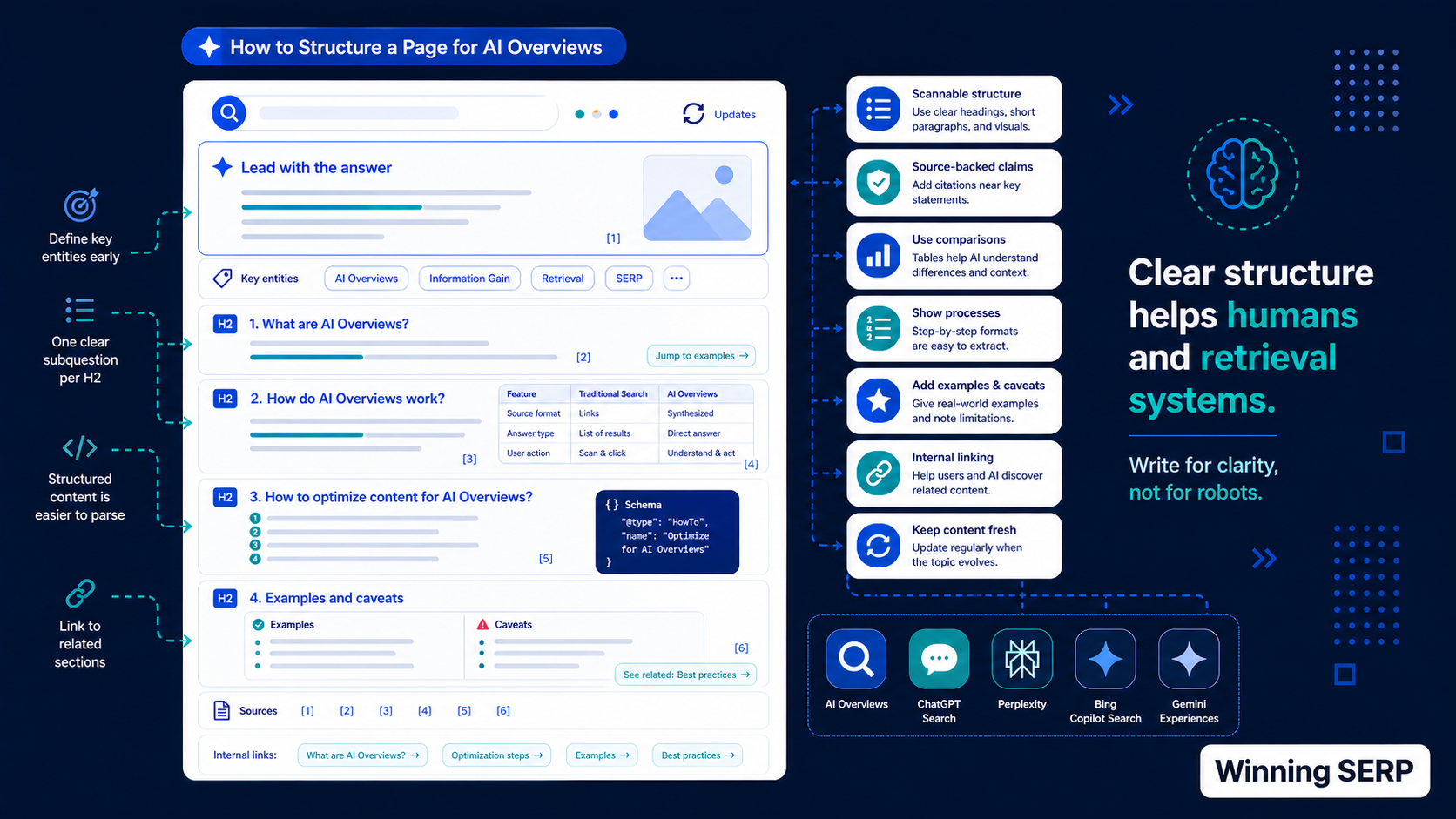
Structure a page so the main answer is obvious, the supporting sections are easy to scan, and each section answers one clear subquestion. This helps readers and gives Google clearer source material.
Use this structure:
- Lead with the answer.
- Use question-based H2s.
- Define key entities early.
- Add tables for comparisons.
- Use ordered lists for processes.
- Include examples and caveats.
- Keep source-backed claims close to their context.
- Link to related internal pages naturally.
- Add schema only when it matches visible content.
- Refresh the page when the topic changes.
This structure also supports AI SEO beyond Google. ChatGPT Search, Perplexity, Bing Copilot Search, and Gemini-style experiences also benefit from clear, source-worthy content.
The goal is not to write for robots. The goal is to write in a way that a busy human and a retrieval system can both understand.
How Do Internal Links Help AI Overview Visibility?
Internal links help AI Overview visibility by making important pages easier to discover and by clarifying relationships between topics. Google explicitly lists findability through internal links as a continuing SEO best practice for AI features.
Internal links do three jobs:
- They help crawlers discover important pages.
- They help users move to deeper context.
- They help Google understand topical relationships.
For an AI Overviews topic cluster, a site might connect:
| Page | Natural Internal Link Role |
|---|---|
| AI Overviews guide | Explains the Google Search feature |
| AI search engines list | Places Google alongside other answer systems |
| How to rank in AI search | Expands beyond Google into mentions and citations |
| Prompt research guide | Shows how to test real AI search questions |
| LLM seeding guide | Explains off-site evidence and third-party sources |
| Technical SEO audit | Covers crawlability, rendering, and indexing |
The links should sit where readers need them. Do not dump them into one paragraph. A link about technical accessibility belongs in the technical section. A link about prompt testing belongs in the measurement or research section.
That is how internal linking becomes useful instead of decorative.
How Does Query Fan-Out Change SEO?
Query fan-out changes SEO because one search can break into multiple hidden subtopics. Instead of optimizing only for one keyword, you need to satisfy the broader information need behind the query.
Google says AI Overviews and AI Mode may issue multiple related searches across subtopics and data sources while generating a response. This means AI visibility can depend on coverage across a topic cluster, not only one exact-match page.
For SEO teams, the implication is practical:
| Old Mindset | Better AI Overview Mindset |
|---|---|
| One keyword, one page | One user task, several supporting pages |
| Exact-match content | Topic coverage and entity clarity |
| Isolated article | Internally linked cluster |
| Ranking only | Ranking, citation, and source usefulness |
| Generic summaries | Answer plus evidence plus examples |
This is why prompt research matters. Long AI-style questions reveal the subtopics a search system may need to answer before it can produce a useful summary.
How Do You Measure AI Overview Performance?
Google reports traffic from AI features such as AI Overviews and AI Mode in Search Console under the Web search type, alongside the rest of Search. Google does not currently give a separate AI Overview filter in the standard Performance report.
That means AI Overview measurement is indirect.
Track these signals:
- Search Console clicks and impressions for queries where AI Overviews appear.
- Organic CTR changes after AI Overviews become more common.
- Query groups that gain or lose visibility.
- Landing pages that receive traffic from complex informational queries.
- Conversion quality from organic traffic.
- Manual SERP observations for priority queries.
- Rank tracking notes where AI Overviews appear.
- User behavior in Google Analytics.
Google has said clicks from search results pages with AI Overviews can be higher quality, meaning users may spend more time on the site. Whether that holds for your site depends on query type, page quality, and conversion path.
The practical reporting approach is to combine Search Console, analytics, manual SERP checks, and your own prompt/keyword monitoring. Do not rely on one screenshot or one query.
Can You Control Whether Your Content Appears in AI Overviews?
You can control crawl access and preview controls, but you cannot selectively opt into AI Overviews as a special feature. Google says AI is built into Search, and robots.txt controls Googlebot access for Search.
If you want to limit how much content appears from a page in Search features, Google points to existing controls:
| Control | What It Does |
|---|---|
noindex | Prevents a page from appearing in Search |
nosnippet | Prevents snippets from being shown |
max-snippet | Limits snippet length |
data-nosnippet | Blocks specific page parts from snippets |
| robots.txt | Controls crawling, not indexing of already-known URLs |
Use these carefully. Restricting snippets or indexing can affect normal search visibility, not only AI features.
For most publishers and businesses, the better question is not “How do we block AI Overviews?” It is “Which pages should be visible, accurate, and source-worthy enough to represent us well?”
What Should Ecommerce Sites Do for AI Overviews?
Ecommerce sites should focus on product clarity, category usefulness, Merchant Center accuracy, structured data, reviews, images, and crawlable buying guidance. Google specifically mentions keeping Merchant Center information up to date as an AI feature best practice when relevant.
AI Overviews can appear for research-heavy ecommerce questions, comparison queries, buying guides, and product education. A category page with thin copy and unclear attributes may be less useful than a guide that explains how to choose.
Useful ecommerce improvements include:
- Product specs in crawlable text.
- Accurate availability and pricing signals.
- Product schema that matches visible content.
- Helpful category intros.
- Buying guides that explain decision criteria.
- Review content that names real use cases.
- Image alt text that describes products accurately.
- Internal links between categories, products, and guides.
The ecommerce opportunity is not only to appear for “buy” queries. It is to become the source Google can use when a user asks, “What should I look for before buying this?”
What Should Local Businesses Do for AI Overviews?
Local businesses should keep their website, Google Business Profile, local citations, service pages, reviews, and location information consistent. AI Overviews can use local context when queries require local recommendations or explanations.
Start with entity consistency:
- Business name.
- Address and service area.
- Phone number.
- Services offered.
- Opening hours.
- Reviews.
- Photos.
- Local proof and case studies.
Then build useful local content. A local service page should explain what the service includes, who it serves, local constraints, pricing logic, FAQs, and proof. Thin city pages with swapped location names are not a durable strategy.
Local AI visibility depends on trust. If your site, Business Profile, directories, and reviews all describe the business consistently, Google has less ambiguity to resolve.
What Should B2B and SaaS Sites Do for AI Overviews?
B2B and SaaS sites should create clear product, use-case, comparison, pricing, integration, documentation, and proof pages. AI Overviews can appear for research and comparison queries where buyers need context before contacting sales.
Useful B2B content includes:
| Page Type | AI Overview Value |
|---|---|
| Use case pages | Explains who the product is for |
| Integration pages | Answers compatibility questions |
| Alternatives pages | Supports comparison intent |
| Pricing pages | Reduces ambiguity |
| Documentation | Provides source-worthy implementation details |
| Case studies | Shows proof and context |
| Security pages | Supports risk and procurement questions |
If your website hides everything behind vague demo CTAs, Google and users may rely on third-party sources to understand the product. That can lead to outdated or incomplete summaries.
Clarity is a competitive advantage.
What Mistakes Should You Avoid?
Avoid treating AI Overview optimization as a shortcut. Most mistakes come from chasing the feature instead of improving the source material.
Common mistakes include:
- Creating “AI Overview optimized” pages with no original value.
- Adding fake schema or schema that does not match visible content.
- Blocking important content in JavaScript-heavy components.
- Hiding answers inside images or PDFs only.
- Publishing AI-generated summaries with no expertise.
- Ignoring internal links.
- Forgetting snippet controls can affect search display.
- Measuring AI Overviews from one manual SERP check.
- Ignoring reviews, profiles, and off-site entity signals.
- Assuming AI Mode and AI Overviews show the same sources.
The safest path is boring in the best way: technical SEO, helpful content, clear entities, source-worthy proof, and steady measurement.
AI Overview Optimization Checklist
Use this checklist when improving a page for AI Overview visibility:
| Area | Check |
|---|---|
| Crawlability | Googlebot can access the page and important resources |
| Indexability | The page is indexable and canonicalized correctly |
| Snippets | Preview controls do not unintentionally block display |
| Main answer | The page answers the primary question early |
| Headings | H2s and H3s describe real subquestions |
| Evidence | Claims have sources, examples, data, or experience |
| Text accessibility | Important content is in crawlable text |
| Media | Images and videos support the explanation |
| Schema | Structured data matches visible content |
| Internal links | Related cluster pages are linked contextually |
| Entity clarity | Brand, author, service, and topic relationships are clear |
| Freshness | Dates, facts, screenshots, and guidance are current |
This checklist also supports classic SEO. That is the point. AI Overview optimization is not separate from good SEO; it is a stricter version of it. When a source page starts to age, content refreshes should improve the actual answer, title, supporting sections, and link context rather than only changing the visible date.
What Should You Do Next?
Start with your most important informational and commercial queries. Search them manually, note whether AI Overviews appear, record cited sources, and compare those sources with your pages.
Then improve the page that should deserve inclusion:
- Make the direct answer clearer.
- Add missing subtopics.
- Improve internal links.
- Add examples, tables, or data.
- Validate schema.
- Check crawlability and indexability.
- Update stale claims.
- Strengthen author and organization signals.
If the page is technically sound but still not cited, widen the evidence system. That may mean better third-party mentions, stronger reviews, original research, clearer service pages, or improved LLM seeding across sources Google and other answer systems can discover.
Final Takeaway
AI Overviews are not a separate SEO universe. They are part of Google Search, and Google says the same fundamental SEO practices still matter.
The shift is that Google can now summarize, synthesize, and cite information in new ways. That makes clarity, structure, trust, and source quality more important.
Optimize for AI Overviews by making your pages genuinely useful: answer the question, explain the context, support the claim, show expertise, and connect the page to the rest of your topic cluster. Pages that can prove trust with clear authorship, first-hand evidence, and verifiable sources are easier to use as reliable source material.
That is how you build visibility that can survive both classic search results and AI-generated search experiences.