








AI can improve a content strategy when it speeds up the work that slows teams down: research, clustering, briefs, drafting, optimization, repurposing, and performance analysis.
It does not replace strategy. It gives strategists, editors, SEO teams, and subject matter experts a faster operating system for turning audience insight into useful content.
The strongest AI content programs still rely on human judgment. AI can suggest topics, summarize competitors, draft outlines, and identify optimization gaps. Editors decide what is worth publishing, what is accurate, what sounds like the brand, and what actually helps the audience.
For AI-assisted content to perform in answer engines, the publishing system also needs LLM-friendly content patterns such as semantic headings, clean markdown exports, source metadata, and extractable tables.
What Is an AI Content Strategy?
An AI content strategy uses artificial intelligence to support the planning, production, optimization, distribution, and measurement of content.
That includes using AI tools to analyze keywords, cluster topics, create briefs, draft first versions, adapt content for multiple channels, maintain brand voice, and find opportunities in traditional search and AI search.
The important distinction is ownership. AI can assist the workflow, but the strategy still needs a human point of view. Without that, teams usually produce more content, but not necessarily better content.
| Content Strategy Layer | How AI Helps | Human Responsibility |
|---|---|---|
| Audience research | Summarizes patterns, questions, objections, and segments | Decide which audience matters commercially |
| Keyword research | Expands seed topics and groups intent patterns | Validate demand, difficulty, and priority |
| Content briefs | Drafts outlines, subtopics, FAQs, and source notes | Shape the angle and quality bar |
| Drafting | Creates first drafts, examples, and variants | Add expertise, accuracy, and differentiation |
| Optimization | Finds missing terms, structure issues, and readability gaps | Avoid over-optimization and preserve usefulness |
| Repurposing | Converts one asset into social, email, video, or sales copy | Match each channel and audience context |
| Measurement | Summarizes performance and suggests next actions | Connect metrics to business goals |
AI content strategy works best when it is treated as a system, not as a shortcut.
Why Should Teams Use AI in Content Strategy?
Teams should use AI in content strategy because it reduces repetitive work and gives marketers more time for judgment, creativity, and analysis.
The core benefits are practical: saving time, lowering costs, automating repetitive tasks, avoiding creative burnout, gathering insights from large datasets, and increasing content output without immediately hiring more creators.
Those benefits are real, but they only become valuable when the team uses the saved time well. A faster draft is useful if editors spend the extra time improving examples, adding original insight, interviewing experts, checking claims, and aligning the content with business priorities.
AI also helps content teams move from isolated blog posts to connected topic systems. It can scan a keyword set, identify shared intent, cluster related terms, and suggest which pages should support each other.
That makes AI especially useful for SEO content writing, where coverage, search intent, internal links, and refresh decisions all affect performance.
For teams that need the broader operating system, an SEO and content marketing strategy connects those AI-assisted tasks to topic selection, distribution, qualified traffic, and long-term growth measurement.
How Should AI Fit Into the Content Workflow?
AI should fit into the workflow as an accelerator at each stage, not as the only decision maker.
Use AI to make the first pass faster. Then use editorial review, data validation, and subject expertise to make the final version better.
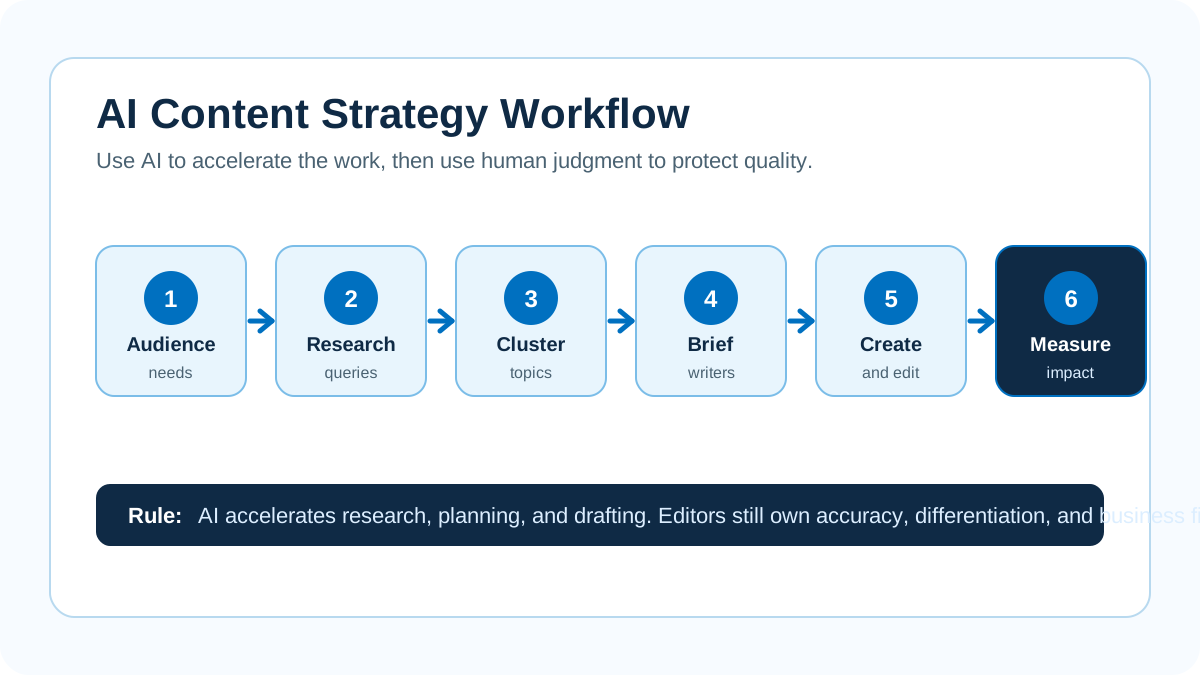
The workflow should answer six questions:
- Who is the content for?
- What problem or decision does the audience need help with?
- Which search queries, AI prompts, and community questions reveal demand?
- Which topic cluster or funnel stage does the asset support?
- What proof, examples, or data will make the asset worth publishing?
- How will the team measure whether it worked?
If AI cannot answer those questions with your inputs, the brief is not ready.
How Can AI Speed Up Keyword Research?
AI speeds up keyword research by expanding seed topics into related ideas, questions, intent patterns, and audience problems.
A chatbot can quickly suggest informational, commercial, navigational, and transactional angles around a topic. For example, a seed topic such as “dog toys” can become questions about puppy toys, chew toys, durable toys, enrichment toys, safety, materials, and buying criteria.
That does not mean AI keyword lists are enough. Chatbots do not reliably know live search volume, ranking difficulty, click potential, or the competitive landscape.
Use AI for expansion, then validate the list with keyword data from tools such as Google Search Console, Semrush, Ahrefs, Google Keyword Planner, or your own site search logs.
The strongest process is:
- Use AI to expand the topic.
- Pull keyword metrics from a real SEO tool.
- Filter by intent and business value.
- Group similar queries into clusters.
- Choose the page type that best matches the intent.
AI is fast at generating possibilities. SEO data is still needed to prioritize them.
How Can AI Tailor Content to the Target Audience?
AI can tailor content to the target audience by turning audience inputs into personas, objections, use cases, and message angles.
Give the model real inputs: customer interviews, support tickets, review excerpts, CRM notes, sales call summaries, survey results, and high-performing pages. Then ask it to identify recurring problems, buyer language, decision triggers, and objections.
This helps content teams avoid generic advice. A guide for startup founders should not sound like a guide for enterprise procurement teams. A local service buyer has different concerns than a SaaS technical buyer.
Useful AI prompts include:
| Prompt Goal | Example Instruction |
|---|---|
| Segment the audience | ”Group these customer notes by buyer type, pain point, and decision stage.” |
| Extract objections | ”List the recurring concerns buyers raise before converting.” |
| Match content to stage | ”Map these questions to awareness, consideration, and decision stages.” |
| Improve specificity | ”Rewrite this section for ecommerce founders with limited technical SEO support.” |
Audience tailoring is where AI becomes more powerful when it has better context.
How Do You Create Better Content Briefs With AI?
Create better SEO content briefs with AI by asking it to combine search intent, audience needs, content gaps, source requirements, and brand direction into one writer-ready plan.
A weak brief only lists a keyword and word count. A useful brief explains what the page must accomplish.
Your AI-assisted brief should include:
- Primary keyword and secondary entities.
- Search intent and funnel stage.
- Target reader and problem.
- Required angle or point of view.
- H2 and H3 structure.
- Questions to answer.
- Internal links to include.
- External sources or data to verify.
- Examples, screenshots, charts, or tables needed.
- Brand voice notes and claims to avoid.
AI can draft this structure quickly, but editors should still check it against the search results, business goals, and actual expertise available.
How Can AI Cluster Keywords and Topics?
AI can cluster keywords by grouping terms with similar intent, meaning, and page requirements.
Keyword clustering helps teams avoid creating five thin pages for terms that should live on one strong page. It also helps identify supporting articles, comparison pages, glossary entries, and commercial landing pages.
For each cluster, ask AI to label:
| Cluster Field | Why It Matters |
|---|---|
| Parent topic | Defines the main page or hub |
| Search intent | Determines the page type and angle |
| Supporting keywords | Guides section coverage and internal links |
| Audience stage | Connects the page to the funnel |
| Content format | Suggests guide, checklist, comparison, template, or service page |
| Differentiation | Prevents the page from copying generic SERP structure |
Then validate the cluster manually. If the search results show different page types for two keywords, they may need separate pages even if the phrases look similar.
How Should AI Optimize Content for Search?
AI should optimize content for search by identifying gaps, not by stuffing keywords.
A good AI review can flag missing subtopics, vague headings, weak introductions, thin examples, unclear calls to action, unsupported claims, and readability issues. It can also suggest title tags, meta descriptions, FAQ ideas, schema opportunities, and internal links.
Use AI to review content against a checklist:
| SEO Element | AI Review Question |
|---|---|
| Title tag | Does it match the search intent and primary offer? |
| Meta description | Does it summarize the value clearly? |
| Headings | Do the H2s answer real user questions? |
| Body content | Does the page include examples, process, and proof? |
| Internal links | Does the page connect to relevant services and guides? |
| AI visibility | Would an answer engine understand the brand, entity, and claim? |
Optimization should make the page more useful. If a suggestion only makes the copy sound more robotic, reject it.
How Do You Keep Brand Voice Consistent With AI?
Keep brand voice consistent by giving AI a documented voice profile, approved examples, and rules for what the brand does not say.
A voice profile should include the audience, tone, sentence style, vocabulary, claims policy, formatting preferences, and examples of approved copy. It should also include banned phrases and patterns that make the content sound generic.
For SEO teams, this matters because AI can quickly flatten every brand into the same voice. The content may be technically correct but forgettable.
Build a brand voice file with:
- Three to five voice traits.
- Example paragraphs that represent the brand.
- Terms the brand uses and avoids.
- Rules for claims, statistics, and citations.
- CTA style and internal linking preferences.
- Examples of before-and-after rewrites.
Then ask AI to revise drafts against the voice file, not against a vague request to “make it better.”
How Can AI Repurpose Content Across Channels?
AI can repurpose content by turning one strong asset into channel-specific versions for social, email, video, sales enablement, and newsletters.
Repurposing works best after the core asset is solid. A weak blog post becomes weak social content. A strong guide can become a LinkedIn carousel, short email sequence, YouTube outline, sales one-pager, and FAQ section.
Use AI to extract:
| Repurposed Asset | AI Can Generate |
|---|---|
| LinkedIn post | Hook, summary, practical takeaway, CTA |
| Subject lines, preview text, short narrative, link CTA | |
| Video outline | Talking points, intro, scene notes, closing prompt |
| Sales enablement | Buyer objections, proof points, comparison notes |
| FAQ | Short answers based on the article |
| Refresh plan | New sections, outdated claims, missing examples |
Editors should adapt each version to the channel. Social copy needs sharper hooks. Email needs a clear reason to click. Sales content needs proof and objections.
How Can AI Scale Content Without Lowering Quality?
AI can scale content when the team scales the process, not only the drafting.
Publishing more pages creates risk. Without quality control, AI-assisted content can become repetitive, inaccurate, thin, or disconnected from the brand.
Use a quality loop before publishing:
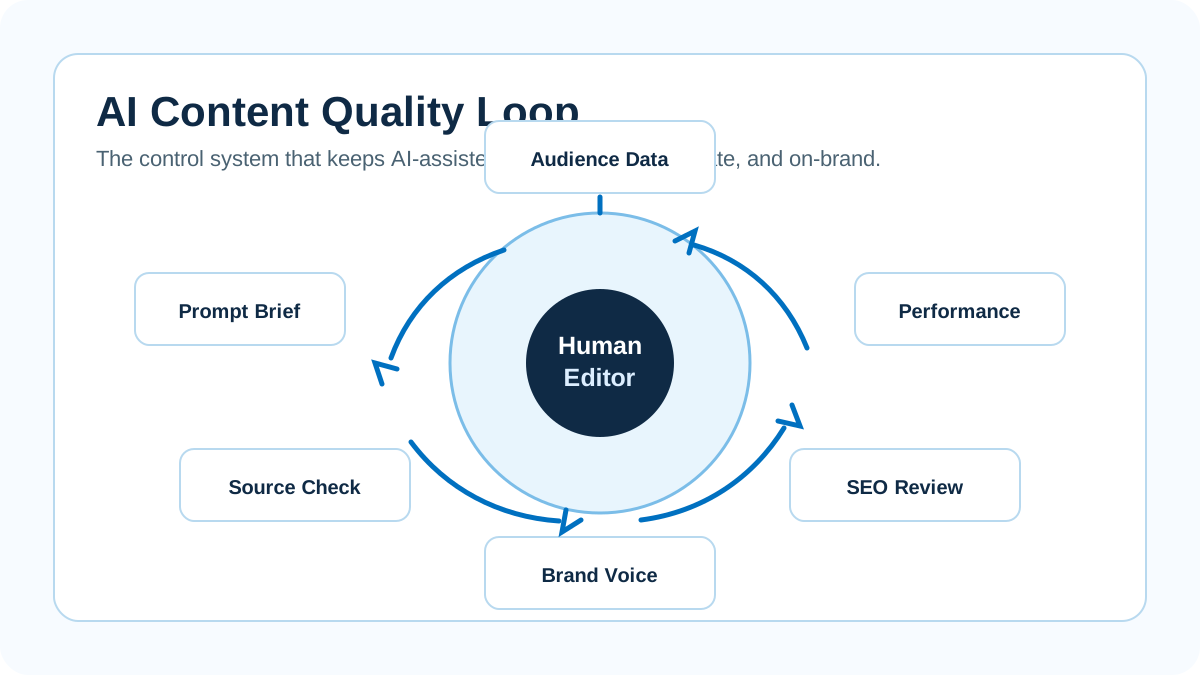
Every AI-assisted article should pass these checks:
- The brief matches a real audience need.
- The search intent is clear.
- Claims are verified against sources.
- Examples are specific and useful.
- The content adds something competitors do not.
- The brand voice sounds human.
- Internal links support the buyer journey.
- The page has a measurable goal.
Scale should mean more useful content, not more interchangeable pages.
How Can AI Improve Visibility in Answer Engines?
AI can improve answer engine visibility by helping teams identify what large language models and AI search systems need to understand, cite, and recommend a brand.
This includes monitoring brand mentions, AI citations, comparison prompts, answer accuracy, and recurring questions. It also includes making owned pages clearer for machines: crawlable HTML, direct answers, structured data, entity consistency, and source-worthy evidence.
For AI visibility, use AI to audit:
| AI Visibility Check | What to Look For |
|---|---|
| Brand prompts | Whether the answer describes the company correctly |
| Category prompts | Whether the brand appears for relevant buyer questions |
| Citation sources | Which URLs and third-party pages support the answer |
| Entity consistency | Whether names, services, people, and profiles match |
| Content gaps | Which questions competitors answer better |
| Review sentiment | Whether external proof supports the positioning |
This connects content strategy with AI SEO services, technical SEO audits, and SEO content writing services.
What Do Marketers Use AI For Most?
Marketers in the provided source most often mentioned content drafting. The surveyed marketers also used AI for topic ideation, competitive research, content outlines or briefs, and keyword research or clustering.
How Marketers Use AI in Content Strategy
Top content strategy tasks mentioned by surveyed marketers in the provided source.
| Content Task | Share of Surveyed Marketers |
|---|---|
| Content drafting | 35.8% |
| Topic ideation | 23.5% |
| Competitive research | 21.6% |
| Content outlines/briefs | 18.8% |
| Keyword research and clustering | 17.9% |
The pattern is useful. Marketers are not only using AI to write. They are using it to plan, research, structure, and improve the strategy around the writing.
That is the healthier model. Drafting saves time, but research and briefing often create more strategic leverage.
What Metrics Should Measure an AI Content Strategy?
Measure an AI content strategy by tracking both efficiency and quality.
Efficiency metrics show whether AI is saving time. Quality metrics show whether the content is worth publishing. Business metrics show whether the strategy is creating value.
Track:
| Metric Type | Examples |
|---|---|
| Efficiency | Brief creation time, draft turnaround time, refresh speed |
| Quality | Editorial revisions, factual corrections, expert review scores |
| SEO performance | Rankings, impressions, clicks, indexed pages, internal link growth |
| Engagement | Scroll depth, conversions, assisted conversions, newsletter signups |
| AI visibility | Mentions, citations, prompt accuracy, AI crawler activity |
| Business impact | Leads, qualified calls, revenue influence, pipeline contribution |
Do not celebrate content volume by itself. A content strategy that produces more low-performing pages is not improving.
What Is the Best Way to Start?
Start with one workflow, one topic cluster, and one measurable goal.
Do not roll AI into every content process at once. Pick a bottleneck. If briefs take too long, start with brief generation. If topic planning is messy, start with clustering. If existing content is decaying, start with refresh old content audits that compare intent, titles, sections, links, and source quality before rewriting.
A practical 30-day plan looks like this:
| Week | Focus | Output |
|---|---|---|
| 1 | Audit content workflow | Bottlenecks, tools, rules, and quality risks |
| 2 | Build prompt and brief templates | Repeatable inputs for research, briefs, and reviews |
| 3 | Produce one topic cluster | One pillar page and supporting content briefs |
| 4 | Measure and refine | Time saved, quality issues, rankings, and next improvements |
The goal is not to automate content strategy. The goal is to make the strategy faster, clearer, and easier to execute without losing the human judgment that makes content worth trusting.