








The best large language model is not always the newest model or the one with the loudest launch. The right LLM depends on the job: reasoning, coding, long-context retrieval, multimodal work, open-source deployment, latency, privacy, and cost.
This guide turns the provided 23-model dataset into a practical comparison for teams choosing an LLM in 2026. It covers proprietary and open-source models, context length, developer coverage, and the decision factors that matter before a model reaches production.
Once a model is chosen, the website still has to give it useful source material. An AI-friendly website makes articles, product pages, and comparison data easier for LLM workflows to summarize accurately.
Which Large Language Models Stand Out in 2026?
The strongest large language models in the provided dataset cluster around a few major providers: OpenAI, Google, Anthropic growth, xAI, Meta AI, DeepSeek, Alibaba, Amazon Web Services, Mistral AI, NVIDIA, Moonshot AI, MiniMax, and Upstage AI.
The dataset includes 23 models. OpenAI appears most often with seven models, while Google, Anthropic, xAI, and DeepSeek each appear twice.
Most Represented LLM Developers
Developers with multiple models in the provided dataset.
| Developer | Models Listed |
|---|---|
| OpenAI | 7 models |
| 2 models | |
| Anthropic | 2 models |
| xAI | 2 models |
| DeepSeek | 2 models |
That does not mean model count equals quality. It means buyers have to compare model families, not just single model names. A provider may offer a flagship reasoning model, a faster mini model, and a multimodal model for different workloads.
What Are the 23 Best LLMs in the Dataset?
The table below preserves the key fields from the provided source: model name, developer, release date, context length, license, and active parameter count when available.
| LLM Name | Developer | Release Date | Context Length | License | Active Parameters |
|---|---|---|---|---|---|
| GPT-5 | OpenAI | August 2025 | 272 thousand | Proprietary | Unknown |
| Llama 4 Scout | Meta AI | April 2025 | 10 million | Open source | 17 billion |
| Grok 4 | xAI | July 2025 | 256 thousand | Proprietary | Unknown |
| Gemini 2.5 Pro | March 2025 | 1 million | Proprietary | Unknown | |
| MiniMax-Text-01 | MiniMax | January 2025 | 4 million | Open source | 45.9 billion |
| o3-pro | OpenAI | April 2025 | 200 thousand | Proprietary | Unknown |
| DeepSeek-R1-0528 | DeepSeek | May 2025 | 128 thousand | Open source | 37 billion |
| GPT-4.1 | OpenAI | April 2025 | 1 million | Proprietary | Unknown |
| Nova Premier | Amazon Web Services | April 2025 | 1 million | Proprietary | Unknown |
| o4-mini | OpenAI | April 2025 | 200 thousand | Proprietary | Unknown |
| o3-mini | OpenAI | January 2025 | 200 thousand | Proprietary | Unknown |
| Gemini 2.5 Flash | April 2025 | 1 million | Proprietary | Unknown | |
| Claude Opus 4 | Anthropic | May 2025 | 200 thousand | Proprietary | Unknown |
| Claude Sonnet 4 | Anthropic | May 2025 | 200 thousand | Proprietary | Unknown |
| Qwen3-235B-A22B-Thinking-2507 | Alibaba | July 2025 | 262 thousand | Open source | 22 billion |
| Llama Nemotron Ultra | NVIDIA | April 2025 | 128 thousand | Open source | Unknown |
| Mistral Medium 3 | Mistral AI | May 2025 | 128 thousand | Proprietary | Unknown |
| DeepSeek-R1 | DeepSeek | January 2025 | 128 thousand | Open source | Unknown |
| Solar Pro 2 | Upstage AI | July 2025 | 66 thousand | Proprietary | Unknown |
| Kimi K2 | Moonshot AI | July 2025 | 128 thousand | Open source | 32 billion |
| o3 | OpenAI | April 2025 | 200 thousand | Proprietary | Unknown |
| Grok 3 Mini | xAI | February 2025 | 1 million | Proprietary | Unknown |
| GPT-4o | OpenAI | March 2025 | 128 thousand | Proprietary | Unknown |
Which LLMs Have the Largest Context Windows?
Llama 4 Scout has the largest reported context window in the dataset at 10 million tokens. MiniMax-Text-01 follows at 4 million tokens.
Large context windows matter when a model needs to work across long documents, codebases, legal files, support logs, research archives, or multi-step agent memory. They do not automatically make a model better for every task.
Largest LLM Context Windows
Selected models from the provided dataset, ranked by reported context length.
| Model | Context Length |
|---|---|
| Llama 4 Scout | 10 million tokens |
| MiniMax-Text-01 | 4 million tokens |
| Gemini 2.5 Pro | 1 million tokens |
| GPT-4.1 | 1 million tokens |
| Nova Premier | 1 million tokens |
| Gemini 2.5 Flash | 1 million tokens |
| Grok 3 Mini | 1 million tokens |
| GPT-5 | 272 thousand tokens |
Long-context models still need good retrieval design. A model can accept a large context and still miss the right detail if the prompt, document structure, or ranking layer is weak.
Which LLMs Are Open Source?
Eight models in the provided dataset are listed as open source, while fifteen are proprietary.
LLM License Mix
Open-source versus proprietary models in the provided 23-model dataset.
| License | Number of Models |
|---|---|
| Proprietary | 15 models |
| Open source | 8 models |
Open-source models matter when teams need self-hosting, tighter data controls, lower inference costs at scale, customization, or deployment flexibility. Proprietary models often lead when teams want managed access, high-end reasoning, multimodal features, tool integrations, and simpler operations.
Neither route is universally better. The tradeoff is control versus convenience.
| License Path | Best Fit | Main Tradeoff |
|---|---|---|
| Open source | Private deployment, customization, cost control, regulated workflows | Requires infrastructure, evaluation, and model operations |
| Proprietary | Fast integration, managed APIs, frontier model access, multimodal workflows | Less control over model weights, hosting, and long-term pricing |
How Should Teams Choose an LLM?
Teams should choose an LLM by matching model strengths to the workflow, then testing with real tasks before committing.
Leaderboard scores can help with discovery, but they rarely capture your internal data, prompt style, latency target, compliance requirements, or user expectations.
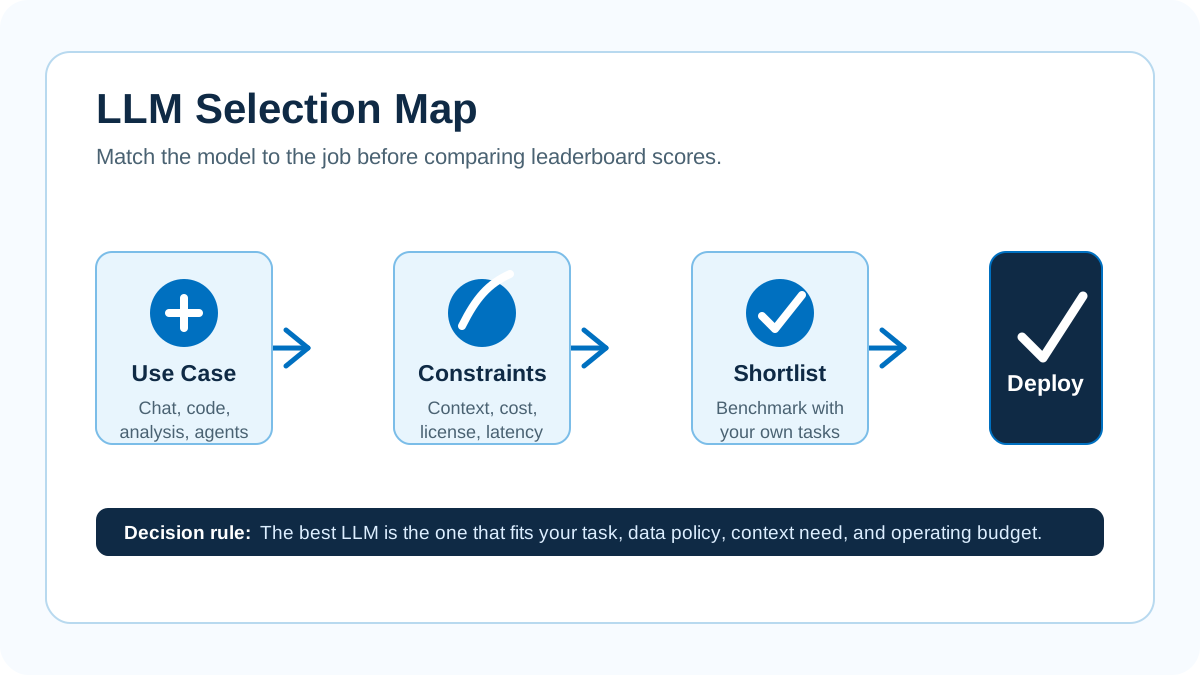
Use this decision sequence:
- Define the task: chat, coding, extraction, retrieval, agentic workflow, support, analytics, or content generation.
- Set the constraints: privacy, hosting, cost, latency, context length, multimodal input, and output quality.
- Shortlist models from both proprietary and open-source options.
- Test them on real prompts, real documents, and real failure cases.
- Measure quality, speed, cost per successful task, and human review burden.
Which LLM Is Best for Long-Document Work?
The best LLM for long-document work is usually one with a large context window plus strong retrieval design. In the provided dataset, Llama 4 Scout, MiniMax-Text-01, Gemini 2.5 Pro, GPT-4.1, Nova Premier, Gemini 2.5 Flash, and Grok 3 Mini stand out on reported context length.
Context length is only the ceiling. The workflow still needs chunking, metadata, citations, source ranking, and guardrails against missed details.
For SEO teams, source ranking also connects to LLM seeding because models and answer systems need credible documents before they can cite or recommend a brand.
For SEO, legal, support, and research workflows, ask whether the model can:
- Keep citations attached to claims.
- Compare documents without blending sources.
- Extract structured fields consistently.
- Handle conflicting information.
- Explain uncertainty instead of forcing an answer.
Which LLM Is Best for Reasoning and Agents?
The best reasoning model depends on the complexity of the task and the budget available for each run. Models such as GPT-5, o3-pro, o3, Claude Opus 4, Claude Sonnet 4, Gemini 2.5 Pro, Grok 4, DeepSeek-R1-0528, and Qwen3 thinking models are positioned for more demanding reasoning workflows in the dataset.
Agentic workflows add extra requirements. The model must follow instructions, use tools, recover from partial failures, preserve context, and decide when to ask for more information.
For production agents, evaluate:
| Capability | Why It Matters |
|---|---|
| Tool use | The model must call search, databases, files, or APIs reliably |
| Planning | The model must break broad requests into correct substeps |
| Verification | The model must check outputs against sources or tests |
| Cost control | Multi-step agents can multiply inference costs quickly |
| Safety boundaries | The model needs clear limits for risky actions |
The strongest agent model is the one that completes the task reliably, not the one that writes the most impressive first answer.
Which LLM Is Best for AI Search and SEO?
The best LLM for AI search and SEO work is one that can reason over content, preserve source fidelity, and output structured recommendations. For many teams, that means testing several models against the same SEO tasks instead of picking one default.
Useful SEO evaluation tasks include:
- Extracting entities from competitor pages.
- Comparing search intent across top-ranking pages.
- Summarizing Google Search Console patterns.
- Building content briefs from SERP evidence.
- Auditing internal links and page templates.
- Creating schema recommendations from visible page content.
- Checking whether AI answers cite or describe a brand accurately.
For Winning SERP, LLM selection connects directly to AI SEO services, technical SEO audits, SEO content writing services, and AI search visibility research.
What Should You Measure Before Adopting an LLM?
Measure task success, not model hype. A model that performs well in a public benchmark may still fail your documents, users, or budget.
Build a small evaluation set before adoption. Include easy tasks, common tasks, edge cases, and examples where the correct answer is “not enough information.”
Track these metrics:
| Metric | What It Reveals |
|---|---|
| Accuracy | Whether the model solves the task correctly |
| Source fidelity | Whether claims match the provided material |
| Latency | Whether the workflow feels usable |
| Cost per completed task | Whether the model scales economically |
| Refusal quality | Whether the model handles unsafe or impossible requests well |
| Formatting consistency | Whether outputs fit downstream systems |
| Human review time | Whether the model saves work after quality control |
The right model is usually discovered through evaluation, not chosen from a single ranking list.
The Practical Takeaway
The best large language model in 2026 depends on the job. GPT-5, Gemini 2.5 Pro, Claude Opus 4, Grok 4, Llama 4 Scout, DeepSeek-R1-0528, Qwen3, and other models can all be the right answer in different contexts.
Start with the workflow. Decide whether you need reasoning, long context, multimodal input, open-source deployment, low cost, low latency, or managed reliability. Then test the shortlist against real prompts and real documents.
That process protects teams from chasing every new release and helps them choose models that actually improve the work.