








Choosing an SEO company is a high-leverage decision. The right partner can improve search visibility, bring qualified traffic, and connect organic search to leads, sales, bookings, or revenue. The wrong partner can waste budget, slow growth, damage trust, or create technical debt that takes months to fix.
The challenge is that many SEO companies sound similar. They promise rankings, traffic, data-driven strategy, technical expertise, and growth. A buyer who does not work in SEO every day may struggle to separate a strong agency from a polished sales pitch.
This guide gives you a practical framework for choosing an SEO company. You will learn which services matter, how to evaluate experience, what questions to ask, how to compare pricing, which red flags to avoid, and how to decide whether an agency is the right fit.
If you want a reference point for how a focused SEO partner can structure services, start with Winning SERP’s SEO services.
Why Is Choosing the Right SEO Company Important?
Choosing the right SEO company is important because SEO affects how customers discover your business when they already have intent. Search visibility can influence brand awareness, lead generation, ecommerce revenue, local calls, demo requests, and long-term acquisition costs.
SEO also compounds. A well-built strategy can keep producing value after the first campaign. A poor strategy can create the opposite effect: thin content, risky backlinks, broken migrations, weak reporting, and confusion about what actually drove results.
The right SEO company helps you:
- Understand where organic search fits in your growth strategy
- Identify technical issues that block performance
- Prioritize keywords and topics based on intent
- Build or improve pages that can rank and convert
- Strengthen site architecture and internal links
- Earn authority through ethical off-page work
- Track results beyond vanity rankings
- Adapt as search changes, including AI search and zero-click behavior
SEO is not just a marketing task. It touches content, development, analytics, conversion rate optimization, brand positioning, local visibility, and customer research. That is why the agency you choose needs more than a checklist. It needs judgment.
What Services Should an SEO Company Offer?
A strong SEO company should offer the services needed to diagnose, improve, and measure organic performance. Not every business needs every service at the same intensity, but the agency should understand how the pieces work together.
Most SEO programs include some mix of technical SEO, on-page SEO, keyword research, content strategy, link building or digital PR, local SEO, analytics, and reporting.
| SEO Service | What It Does | When It Matters Most |
|---|---|---|
| SEO audit | Diagnoses technical, content, keyword, and authority issues. | Before a strategy, migration, redesign, or retainer. |
| Technical SEO | Improves crawlability, indexation, speed, schema, and site structure. | Sites with performance issues, large catalogs, or complex CMS setups. |
| Keyword research | Finds search demand and maps it to pages. | Any campaign that needs traffic with commercial or informational intent. |
| On-page SEO | Improves page titles, headings, copy, internal links, and intent alignment. | Existing pages that underperform or need better relevance. |
| Content strategy | Plans content that supports visibility and conversions. | Blogs, resources, SaaS sites, ecommerce stores, and publishers. |
| Link building or digital PR | Builds authority through earned mentions and links. | Competitive markets where content alone is not enough. |
| Local SEO | Improves visibility in local results and maps. | Service businesses, clinics, stores, restaurants, and local brands. |
| Reporting | Connects SEO activity to metrics and business outcomes. | Every ongoing SEO relationship. |
An agency does not need to do everything in-house, but it should be honest about what it delivers directly, what it partners on, and what it expects your team to handle.
What Does On-Page SEO Include?
On-page SEO improves individual pages so search engines and users understand them more clearly. It includes title tags, meta descriptions, headings, content structure, keyword alignment, internal links, image alt text, and conversion-focused copy.
Good on-page SEO starts with search intent. A service page should answer buying questions. A blog post should answer the informational query. A category page should help users compare options. A location page should prove relevance to a real market.
When evaluating an SEO company, ask how they decide whether a page should be created, rewritten, consolidated, or removed. A serious agency will talk about intent, competing pages, internal links, content quality, and conversions. A weak agency may only mention keyword density or meta tags.
What Does Technical SEO Include?
Technical SEO improves the infrastructure that allows search engines to crawl, render, index, and understand a website. It includes crawl errors, indexation, robots.txt, XML sitemaps, canonical tags, redirects, Core Web Vitals, structured data, JavaScript rendering, and site architecture.
Technical SEO matters more when a website is large, old, slow, recently migrated, built on a complex CMS, or dependent on templates. Ecommerce stores, marketplaces, publishers, SaaS websites, and multi-location brands often need deeper technical work.
Ask potential agencies how they handle technical recommendations. Do they provide developer-ready tickets? Do they QA implementation? Do they prioritize issues by business impact? Do they explain when a technical issue is urgent versus merely nice to fix?
The answer matters because many audits produce long lists of issues without prioritization. A good technical SEO partner helps you decide what to fix first.
What Does Keyword Research Include?
Keyword research identifies the search terms your audience uses and maps them to the right pages. It should go beyond volume. A strong keyword strategy considers search intent, business value, competition, funnel stage, SERP features, seasonality, and whether your website has enough authority to compete.
A good SEO company will not target keywords only because they are popular. It will ask whether the query can attract the right customer.
For example, a broad informational keyword may bring traffic but few leads. A lower-volume service keyword may bring fewer visits but better sales opportunities. The best strategy usually balances both.
Ask agencies how they group keywords into topics, how they map them to existing pages, and how they find gaps against competitors. Their answer will reveal whether they understand strategy or only export keyword lists from tools.
What Does Content Marketing Include?
SEO content marketing uses search data, audience research, and editorial strategy to create content that earns visibility and supports business goals. It can include service pages, blog posts, guides, comparison pages, case studies, landing pages, product copy, and resource hubs.
Content quality matters more than publishing frequency. A company that publishes weak articles every week may make little progress. A company that publishes fewer but better-targeted pieces can often gain more qualified visibility.
When evaluating an SEO company, ask how they create briefs, involve subject matter experts, update old content, measure content performance, and decide when content should support conversion instead of only traffic.
SEO content should not read like generic filler. It should show expertise, answer real questions, and help buyers make decisions.
What Does Link Building Include?
Link building and digital PR help your site earn authority from other websites. In competitive markets, strong content and technical foundations may still need external authority to rank.
Ethical link building can include digital PR campaigns, expert commentary, data studies, guest contributions, resource link building, unlinked brand mention outreach, partnerships, and genuinely useful assets.
Risky link building includes paid link schemes, private blog networks, irrelevant guest posts, automated links, link farms, and tactics that exist only to manipulate rankings. These may create short-term movement but can expose your site to penalties or long-term trust problems.
Ask every SEO company how they build links. If they cannot explain sources, quality standards, relevance, and risk, keep looking.
What Does Local SEO Include?
Local SEO helps businesses appear in local organic results, map packs, and Google Business Profile surfaces. It matters for businesses that serve customers in specific cities, regions, or service areas.
Local SEO can include Google Business Profile optimization, local landing pages, review strategy, citations, local links, service-area pages, schema, NAP consistency, and localized content.
If you run a local business, ask whether the agency understands calls, bookings, directions, map visibility, service areas, and location-specific conversion tracking. Local SEO is not just adding a city name to a page.
How Do You Choose an SEO Company?
Choose an SEO company by defining your goals first, then evaluating agencies against fit, proof, services, transparency, pricing, process, ethics, and communication. The best agency for another business may not be the best agency for you.
Use this eight-step process before signing a contract.
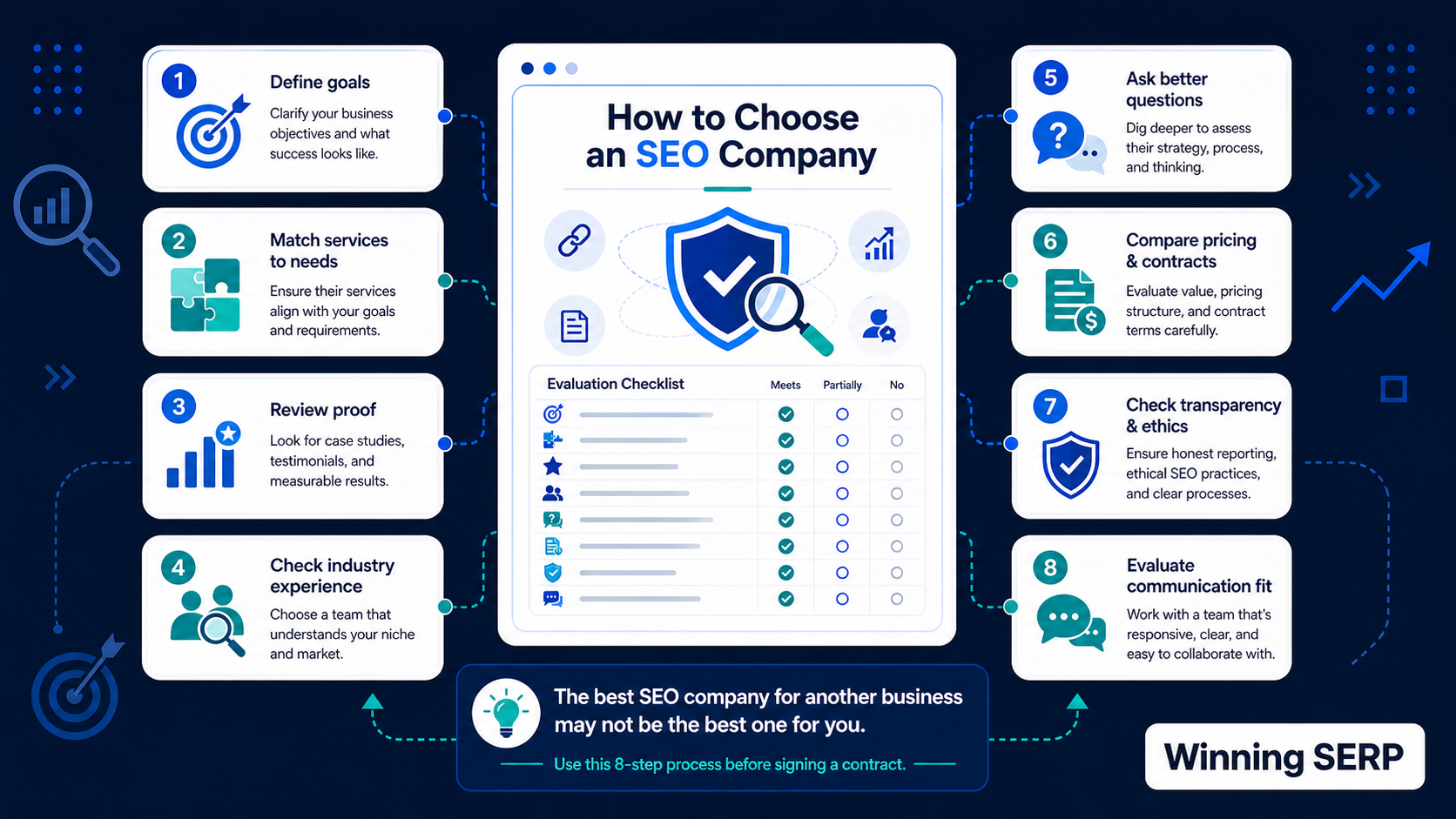
Step 1: Define Your SEO Goals and Business Objectives
Start by defining what you want SEO to achieve. Clear goals help you choose the right agency and avoid paying for activity that does not support your business.
Common SEO goals include:
- Increase qualified organic traffic
- Generate more leads or demo requests
- Improve ecommerce revenue
- Grow local calls and appointments
- Recover from a traffic decline
- Improve technical health
- Support a website migration
- Expand into new locations
- Build topical authority
- Improve AI search and answer engine visibility
Your goals should also include constraints. Do you have developers available? Can your team publish content? Are you in a regulated industry? Do you need multilingual SEO? Are you trying to grow quickly or stabilize a declining site?
An SEO company cannot build the right plan without this context.
Step 2: Match Services to Your Actual Needs
Match the agency’s services to the problems your website actually has. A website with severe crawl and indexation issues may need technical SEO before content production. A local service business may need location pages and Google Business Profile work before a large blog strategy. An ecommerce store may need category architecture before link building.
This is where many businesses make the wrong choice. They buy the service an agency prefers to sell instead of the service the site needs.
Ask each agency what they would prioritize in the first 90 days and why. A thoughtful answer should include tradeoffs. If every problem is described as equally urgent, the agency may not have a strong prioritization process.
Step 3: Review Case Studies and Proof
Case studies show whether an SEO company can turn strategy into results. Look for case studies that explain the starting problem, strategy, implementation, timeline, and outcome.
Strong case studies usually include:
- The client’s industry or business model
- The starting challenge
- The SEO strategy
- The work completed
- The time period
- The metrics improved
- Context about what changed
Be cautious with vague screenshots and isolated ranking wins. A keyword moving from position eight to position three can matter, but only if it connects to business value.
If an agency cannot share public case studies because of confidentiality, ask for anonymized examples or references. They should still be able to explain how they approach problems.
Step 4: Evaluate Industry and Website Experience
Industry experience can shorten the learning curve. An agency that has worked with companies like yours may understand buyer intent, content requirements, compliance issues, sales cycles, and competitive SERPs faster.
Website type also matters. Local SEO, SaaS SEO, ecommerce SEO, enterprise SEO, publisher SEO, and marketplace SEO require different skills.
For example:
| Business Type | SEO Needs |
|---|---|
| Local service business | Google Business Profile, local pages, reviews, calls, and map visibility. |
| Ecommerce store | Category pages, product pages, schema, faceted navigation, and organic revenue. |
| SaaS company | Product-led content, comparison pages, technical docs, demos, and trials. |
| Enterprise website | Stakeholder management, technical SEO, governance, templates, and migrations. |
| Publisher | Indexation, topical authority, freshness, internal linking, and content operations. |
Do not require identical industry experience in every case. Sometimes a strong agency with adjacent experience and a smart discovery process can outperform a niche agency with weak execution. But make sure they understand the type of website you run.
Step 5: Ask Better SEO Company Questions
Ask questions that reveal process, judgment, ethics, and communication. Good agencies usually welcome detailed questions because they separate serious buyers from price shoppers.
Use questions like these:
| Question | What a Strong Answer Shows |
|---|---|
| How would you diagnose our current SEO performance? | They start with data, context, and business goals. |
| What would you prioritize in the first 90 days? | They can sequence work instead of listing everything. |
| How do you measure SEO success? | They track business outcomes, not only rankings. |
| How do you handle technical recommendations? | They can work with developers and QA fixes. |
| How do you create content briefs? | They understand intent, expertise, and conversion. |
| How do you approach link building? | They avoid risky or low-quality tactics. |
| Who will work on our account? | They are transparent about team structure. |
| How often will we communicate? | They have a clear operating rhythm. |
| What do you need from us to succeed? | They understand SEO is collaborative. |
| What results are realistic in six months? | They set expectations without guarantees. |
Listen for specificity. A weak answer often sounds impressive but says little. A strong answer explains how decisions are made.
Step 6: Compare Pricing and Contract Terms
Compare SEO pricing by scope, value, team quality, and expected involvement, not only monthly cost. Cheap SEO can become expensive if it creates weak content, bad links, or poor technical recommendations.
SEO pricing varies because every website has different competition, technical debt, content needs, authority gaps, and implementation resources.
Common pricing models include:
| Pricing Model | Best For | Watch For |
|---|---|---|
| Monthly retainer | Ongoing SEO strategy and execution. | Undefined deliverables or unclear priorities. |
| Fixed project | Audits, migrations, keyword research, or strategy projects. | Scope creep and missing implementation support. |
| Hourly consulting | Advisory work, training, or expert review. | Limited execution capacity. |
| Performance-based SEO | Specific lead or revenue models. | Attribution problems and risky incentives. |
Review contract length, cancellation terms, ownership of work, reporting cadence, included deliverables, out-of-scope fees, and who owns accounts, content, and data.
Be wary of guaranteed rankings. No ethical SEO company controls Google’s algorithm.
Step 7: Check Transparency and Ethical Practices
Transparency matters because SEO work can be hard to inspect from the outside. A good agency explains what it is doing, why it matters, and how progress will be measured.
Ethical SEO companies avoid manipulative shortcuts. They do not hide tactics behind vague language. They do not buy low-quality links, stuff keywords, create doorway pages, or publish mass-produced content with no expertise.
Look for signs of ethical practice:
- Clear methodology
- Transparent reporting
- Named deliverables
- Honest timelines
- White-hat link standards
- No ranking guarantees
- Willingness to explain tradeoffs
- Ownership of accounts and assets stays clear
If an agency refuses to explain its process because it is “proprietary,” be careful. Strategy can be proprietary. Basic transparency should not be.
Step 8: Evaluate Communication and Cultural Fit
SEO requires ongoing collaboration. Even a technically excellent agency can fail if communication is confusing, slow, or disconnected from your team’s workflow.
Evaluate how the agency communicates during the sales process. Do they listen? Do they ask smart questions? Do they explain concepts clearly? Do they respond with useful detail? Do they understand your constraints?
Also ask who will be your day-to-day contact. Sometimes the senior strategist appears in sales calls but disappears after the contract is signed. Make sure you know who will lead strategy, who will execute, and how often you will speak.
The right agency should feel like a partner, not a black box.
What Are Red Flags When Hiring an SEO Company?
Red flags include guaranteed rankings, vague deliverables, suspiciously low pricing, secret methods, poor reporting, risky link building, and pressure to sign before you understand the scope.
Watch for these warning signs:
- “We guarantee position one.”
- “We have a special relationship with Google.”
- “You do not need to know how we build links.”
- “SEO results happen in 30 days.”
- “We publish hundreds of pages per month with AI.”
- “Reporting is only rankings.”
- “Technical implementation is not our concern.”
- “All industries use the same SEO strategy.”
- “You must sign today to get this price.”
- “We own your content, accounts, or analytics data.”
Some red flags are subtle. If an agency never asks about revenue, leads, margins, sales process, customer quality, or internal resources, it may be optimizing for traffic without understanding the business.
How Should an SEO Company Report Results?
An SEO company should report completed work, performance changes, business impact, issues found, and next priorities. A report should help you understand progress and make decisions.
A useful report may include:
- Organic clicks and impressions
- Priority keyword movement
- Conversions from organic search
- Revenue or lead quality signals
- Technical fixes completed
- Pages created or optimized
- Content performance
- Local actions, calls, or map visibility
- Links or mentions earned
- Risks and blockers
- Next month’s priorities
Avoid agencies that only send automated dashboards without analysis. Dashboards show data. Strategy explains what the data means.
Ask for a sample report before signing. This gives you a realistic view of how the agency communicates after the sale.
Should You Hire an SEO Company or Build In-House?
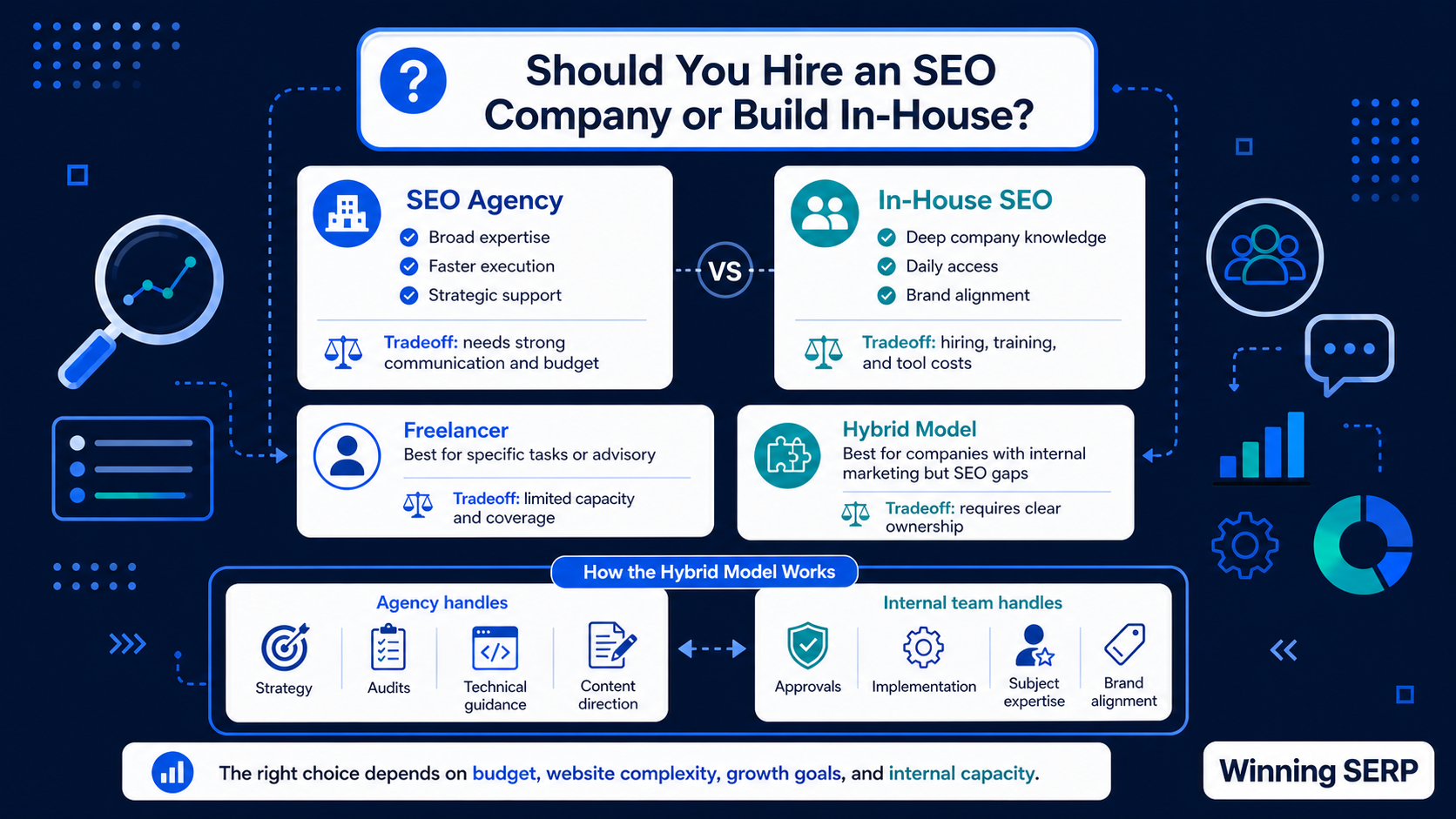
Hire an SEO company when you need specialized knowledge, faster execution, or strategic support that your internal team cannot provide. Build in-house when SEO is central to your company and you have enough ongoing work to justify dedicated hires.
Many businesses use a hybrid model. The agency handles strategy, audits, technical guidance, and content direction. The internal team handles approvals, implementation, subject matter expertise, and brand alignment.
| Option | Best For | Tradeoff |
|---|---|---|
| SEO agency | Access to broad expertise and execution capacity. | Requires good communication and budget. |
| In-house SEO | Deep company knowledge and daily access. | Hiring, training, and tool costs. |
| Freelancer | Specific tasks or advisory support. | Limited capacity and coverage. |
| Hybrid model | Companies with internal marketing but SEO gaps. | Requires clear ownership. |
The right choice depends on your budget, website complexity, growth goals, and internal capacity.
How Many SEO Companies Should You Compare?
Compare three to five SEO companies. Fewer than three may not give you enough perspective. More than five can slow the process and make comparisons confusing.
Use the same evaluation criteria for each agency:
- Relevant experience
- Strategic diagnosis
- Service fit
- Team structure
- Case studies
- Reporting quality
- Pricing clarity
- Communication style
- Ethical standards
- Contract terms
Create a scorecard if multiple stakeholders are involved. This keeps the decision grounded in evidence instead of whichever agency had the most polished pitch.
What Should Happen After You Choose an SEO Company?
After you choose an SEO company, the first phase should focus on discovery, access, auditing, strategy, and prioritization. Strong agencies do not immediately start publishing content or building links without understanding the website.
Expect the onboarding process to include:
- Access to Google Search Console and Google Analytics
- CMS or staging access when needed
- Business goals and conversion definitions
- Competitor list
- Target services, products, or locations
- Previous SEO work and reports
- Technical crawl
- Keyword and content review
- Backlink review
- Roadmap and first priorities
The first 30 to 60 days often shape the whole relationship. A clear roadmap reduces confusion and helps both teams understand what success should look like.
Why Choose Winning SERP as Your SEO Partner?
Winning SERP focuses on practical SEO strategy, technical clarity, content quality, and measurable organic growth. Our work is built for businesses that want SEO tied to real outcomes, not vague monthly activity.
We help businesses improve search visibility through audits, technical SEO, keyword strategy, content optimization, local SEO, ecommerce SEO, link building strategy, reporting, and AI search readiness.
Our approach emphasizes:
- Clear priorities
- Transparent recommendations
- Business-focused reporting
- Search intent and content quality
- Technical foundations
- Ethical SEO practices
- Long-term organic growth
If you are comparing SEO partners and want a clear view of how Winning SERP can support your goals, review our SEO services.
What Are the Latest SEO Trends To Ask About?
Ask SEO companies how they are adapting to AI search, zero-click results, helpful content standards, entity optimization, technical performance, and changing user behavior. SEO is not static.
Important topics to discuss include:
- AI Overviews and answer engine visibility
- Entity-based SEO
- Structured data
- Helpful content and E-E-A-T signals
- Content refresh and pruning
- Core Web Vitals
- JavaScript SEO
- Local search changes
- Ecommerce SERP features
- First-party data and conversion tracking
You do not need an agency that chases every trend. You need one that understands which changes matter for your business and which distractions to ignore.
What Is the Final Checklist for Choosing an SEO Company?
Use this checklist before signing:
| Evaluation Area | What To Confirm |
|---|---|
| Goals | The agency understands your business objectives. |
| Services | The scope matches your actual SEO needs. |
| Proof | Case studies or examples show relevant experience. |
| Strategy | The first 90 days have clear priorities. |
| Reporting | Reports connect activity to outcomes. |
| Ethics | The agency avoids risky tactics and guarantees. |
| Pricing | Deliverables, payment terms, and exclusions are clear. |
| Team | You know who will work on the account. |
| Communication | Meeting cadence and response expectations are defined. |
| Ownership | You retain access to accounts, data, and assets. |
If an agency checks these boxes and communicates clearly, you are much closer to a strong partnership.
Conclusion
Choosing the right SEO company requires more than comparing prices or scanning a few testimonials. You need to define your goals, understand which services matter, evaluate proof, ask better questions, review pricing, check ethics, and judge communication fit.
The best SEO partner will explain the work clearly, connect strategy to business outcomes, and help you prioritize the highest-impact opportunities first. They will not promise instant rankings or hide behind jargon.
Winning SERP represents the qualities businesses should look for in an SEO company: focused SEO expertise, transparent reporting, technical clarity, ethical execution, and strategies built for long-term search performance. Explore our SEO services when you are ready to compare a practical SEO partner against your selection checklist.